Showing posts with label China. Show all posts

Thursday, March 20, 2008

Tainted Drugs

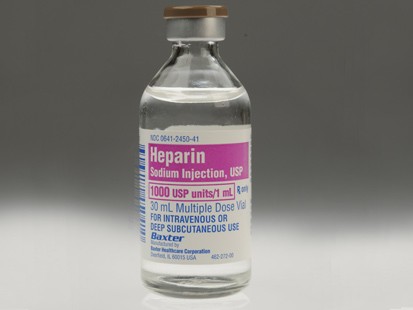
For the sake of people susceptible to earworms everywhere, I won't actually parody the Soft Cell song further than using it as a title here. And as alliterative and 80s-referential as the title is, it's also accurate: in recent weeks, almost two dozen people have died, and their deaths have been linked to contaminated heparin. This morning, the contamination (hypersulfated chondroitin sulfate) was announced, as was the fact that the contamination happened somewhere in China. Because hypersulfated chondroitin sulfate mimics heparin in standard safety tests, it looks likely that the contamination was intentional, likely done by someone trying to either cut costs or boost profits somewhere along the production line.

Congress is, of course, clamouring for action, and the FDA is defending itself, saying it's chronically undermanned and cannot realistically fulfill its broadranging mandate. The same exact reactions we saw in 1999, when contaminated antibiotics from China were linked to almost as many deaths. And since then, China has grown in exports, while the FDA has remained virtually stagnant in the number of inspections; latest numbers indicate the US imports almost a quarter of its medications from China, and only 6% are inspected by the FDA.

With this latest tainted drugs scandal, the Senate has passed a 20% increase in budget for the FDA, but realistically, when the FDA is admitting that they are violating their own policies, suffering from poor management, and whatever other excuse it can pull out of its hat'o'excuses, it seems likely that the additional $375 million is just going to be a bandaid over a much greater problem: the need to reorganize the FDA.

Connecticut Democratic Representative Rosa DeLauro joins me on the skeptic train, saying that she doesn't "want to throw money at an agency that doesn’t have the infrastructure to carry out its mission.” Going a step further than I've actually said, she also notes that top agency officials are incompetent, and the only way any genuine change will happen is a completely new administration for the agency.

News of contaminants from China is not new - this time around, it was heparin. It's been antibiotics in the past. A year ago, dozens of people lost beloved pets to contaminated pet food. Our children's toys have been recalled because of lead and other contaminants. There are two trends here, that cannot be ignored: the FDA is unable to protect the American public, and there is rampant and dangerous corruption in China that does more than just hurt its own population, it affects us all. We, as a people, need to step up and stop accepting the excuses of the FDA and demand reform - and we need to demand a very different sort of relationship with China and the goods we import from them.
-Kelly

Thursday, January 31, 2008

Tainted Drugs*

A state-owned Chinese pharmaceutical company is at the heart of an international drug scandal after it's been revealed that over 200 patients were paralyzed or otherwise hurt by tainted leukemia drugs last summer. But in what we sometimes cynical Westerner's might consider a surprise, given recent cover-up history (especially regarding lead in toys), China's Food and Drug Administration has been at the heart of chasing down the pharma company managers, and responsible for closing the plant when the tainted drugs were discovered.

This would be alarming news to receive about any major pharma company, regardless of their involvement in the import/export industry, but the fact that Shanghai Hualian is the sole supplier of mifepristone (RU-486) for the United States raises even bigger concerns.

So far, the contaminated medications have been isolated to a factory about an hour away from the one that makes RU-486, but obviously when a company has one manufactoring problem, concern spreads to the entire system.

The United States Food and Drug Administration declined to answer questions about Shanghai Hualian, because of security concerns stemming from the sometimes violent opposition to abortion. But in a statement, the agency said the RU-486 plant had passed an F.D.A. inspection in May. “F.D.A. is not aware of any evidence to suggest the issue that occurred at the leukemia drug facility is linked in any way with the facility that manufactures the mifepristone,” the statement said.

When told of Shanghai Hualian’s troubles, Dr. Sidney M. Wolfe, a leading consumer advocate and frequent F.D.A. critic, said American regulators ought to be concerned because of accusations that serious health risks had been covered up there. “Every one of these plants should be immediately inspected,” he said.

The director of the Chinese F.D.A.’s drug safety control unit in Shanghai, Zhou Qun, said her agency had inspected the factory that produced mifepristone three times in recent months and found it in compliance. “It is natural to worry,” Ms. Zhou said, “but these two plants are in two different places and have different quality-assurance people.”


And while I do see this point, and agree with it to a degree, but given recent concerns both about the FDA and it's process, as well as China covering up manufacturing and health issues... I would certainly feel a lot better if the FDA released something more concrete than a no comment. That the FDA won't reveal what other medications are made/imported by the company also is worrisome. Again, on the one hand, I can understand not wanting to run consumers off by fear - but on the other hand, a lot of pets died because of contaminated food. Do we want to see the same health risks in our medications?

-Kelly

(*And as an aside, apologies to anyone else who now has Soft Cell's Tainted Love spinning 'right round in their head.)
-Kelly

Tuesday, December 18, 2007

Pollan on Pollen-Patties and Porcine MRSA

Michael Pollan critiques the lip service paid to the word "sustainability" and shines a light on two larger crises that have roots in our food production system: "Our Decrepit Food Factories". (NYT)

He suggests that the rise of "community-acquired MRSA" (infections not from hospital exposure) stems from our excessive use of antibiotics in raising livestock, especially pigs. With 70% of the antibiotics used in America being fed to our livestock, it is certainly feasible that we are cultivating tomorrow's disease even as we grow today's dinner (UCS). What is so ironic is that comparisons between CAFOs (Confined Animal Feeding Operations) with humanely grown livestock end up with comparable cost-gain ratios, with the former spending less money on animal welfare and more on survival tactics like antibiotics, while the latter pays more up-front for smaller-scale operations but has considerably lower costs when fewer animals become ill from poor conditions. Not only should this serve as a call for a paradigm shift in how we expect our food to be produced, but it also shows a severe failure on the part of the FDA and other public health entities in letting this issue fall into their corporate-induced blind spot.

Pollan also explores the current decimation of our honeybees due to Colony-Collapse disorder, and points out the extreme stress that commercial monocultures like almond growing places on the bees. The stress reduces the effectiveness of their immune systems, and unchecked mingling of large numbers of hives from across the country at almond groves increases the chance of being exposed to viruses like Israeli Acute Paralysis Virus (implicated for causing CCD). In China, there are no more honeybees, and the only thing keeping their agricultural system running is a caste of nearly slave-class people whose job it is to hand-pollinate flowers of fruit trees. Fortunately for China (and for us, since much of our produce, including apples, is imported from there), they don't worry about niggling issues like worker rights and workers' compensation.

The running theme throughout stories like these are that the commodification of organisms and the hubris of complete disregard for the integrity of natural systems of checks and balances could be the source of our downfall. The irony is that each step we take to try to reassert our mastery of Nature is driving us further into this mire of public health threats and looming collapse of the agricultural economy.

Pollan concludes with this:

We’re asking a lot of our bees. We’re asking a lot of our pigs too. That seems to be a hallmark of industrial agriculture: to maximize production and keep food as cheap as possible, it pushes natural systems and organisms to their limit, asking them to function as efficiently as machines. When the inevitable problems crop up — when bees or pigs remind us they are not machines — the system can be ingenious in finding “solutions,” whether in the form of antibiotics to keep pigs healthy or foreign bees to help pollinate the almonds. But this year’s solutions have a way of becoming next year’s problems. That is to say, they aren’t “sustainable.”

From this perspective, the story of Colony Collapse Disorder and the story of drug-resistant staph are the same story. Both are parables about the precariousness of monocultures. Whenever we try to rearrange natural systems along the lines of a machine or a factory, whether by raising too many pigs in one place or too many almond trees, whatever we may gain in industrial efficiency, we sacrifice in biological resilience. The question is not whether systems this brittle will break down, but when and how, and whether when they do, we’ll be prepared to treat the whole idea of sustainability as something more than a nice word.


(Additionally, Pollan has a new book soon to be released: In Defense of Food: An Eater's Manifesto.)

Wednesday, January 03, 2007

China's Henan Provence Bans Abortion Drugs

In their continuing effort to stem their increasingly gender imbalanced population, China's Henan province has banned abortion drugs, after admitting that sex-based abortions (despite being illegal) are still widespread.

Unfortunately, I suspect this will simply do one of two things: either make abortions more dangerous by making them back alley (even if drug-based back alley), or increase the number of female babies abandoned in orphanages.