Showing posts with label diy biotech. Show all posts

Wednesday, February 17, 2010

DIY Synthetic Biology - More Than Building a Better Tomato

A few years in his book, A Many-Colored Glass, Freeman Dyson envisioned that the domestication of biotechnology would result in a new art form, as creative as painting or sculpture and would give rise to an explosion of new diverse creatures, few of which will be masterpieces, but “all will bring joy to their creators and variety to our flora and fauna.”  Now, college biology students are competing to see who can create new, living tools to address the planet's problems (e.g., bacteria that   The comments and reactions to the article range from go-get-'em to we-are-destroying-ourselves-and-the planet to philosophical:

Sample comment 1

Genetic engineering by experienced professionals is dangerous enough.

Genetic engineering by students is a spectacularly bad idea.


Sample comment 2:


Mary Shelley's Frankenstein remains a compelling story these many years later  because of its description of what it means to be human, and what happens when we overreach. We can't bury our heads in the sand, we can't put the genie back in the bottle, but perhaps we can ask the question, "Should we do it just because we can do it?"

Sample comment 3:


lots of pluses and minuses here - 
Plus: poor countries can home brew their own genetically engineered crops and not have to rely on multinationals and their morally odious "patenting" of genetic  sequences (many of which started as novel genetic strains they freely took from poor countries).

Minus: Al Qaeda can brew its own deadly flu strain. Possibly killing many poor Muslims would not be a problem for Al Qaeda.


Welcome to the age of genetic hacking. Just like computer hacking, except we're the vector, not our computer.

Sample comment 4[I suspect a bioethicist wrote this one]


Any technology can be used to accomplish useful things, or abused to accomplish evil things. The fault lies with personal ethics, not the technology itself. Our students are carefully versed in the implications of biotechnology as well as the applications and limitations.  It is important to expose students to ethical considerations in the use of technology. Our students are far more informed on these issues than the general public.

Regardless of your position on whether or DIY genetic engineering kits are a good idea, this article does provide evidence that the field of bioethics is not dying or irrelevant; if anything, it is now needed more than ever.

Thursday, April 24, 2008

Continuing Coverage: Abortion as Art

The debate around Aliza Shvarts' abortion as art project/social commentary continues as Yale officials now say that without a disclaimer clearly stating the entire project is a work of fiction/hoax and contains no human blood, and is merely performance art.
"In this case, we will not permit her to install the project unless she submits a clear and unambiguous written statement that her installation is a work of fiction: that she did not try to inseminate herself and induce miscarriages, and that no human blood will be physically displayed in her installation," Peter Salovey, dean of Yale College, said in the statement.
Additionally, Yale officials have said that Shvartz' advisers made serious errors in judgment in approving the project once they were aware of the controversial nature of the piece; the faculty involved have apparently been spoken to with "appropriate action" taken.

Now, this raises even further questions for me. First - if Shvarts presented the project to her faculty advisers as a performance piece/hoax project designed to get the rise that is has been out of us chatty media commentators, why would the faculty raise questions, or seek additional approval? On the face of it, if you want to believe that this is a performance piece and not actually what Shvartz says it is - the result of repeated attempts to inseminate and then herbaly abort resulting pregnancies - then what's the problem? Gelatin, food colouring, plastic, a controversial artist statement, and the precise results any performance artist is hoping to achieve. And if she lied to the advisers, why does this then become something that they should be punished for?

Secondly, the automatic ban on art that contains human body fluids/cast-offs strikes me as stepping very close to censoring art because it is controversial. Many modern, performance, and even "traditional" artists work in human fluids - is this really the appropriate response for officials to have to controversial art?

At this point, unless someone goes in with Luminol or DNA swabs and then runs PCRs, etc, we're never going to know if she actually did what she said - in a way, it's a wonderful example of just how flexible truth and knowledge actually is.
-Kelly Hills

Saturday, April 19, 2008

Abortion as Art Debate Continues

Aliza Shvarts abortion as art Yale senior art project is continuing to create controversy. Originally billed as a student deliberately impregnating and aborting over the span of many months, and saving the fluids for an art project, was labeled fictitious performance art by Yale - a statement Shvarts immediately called inaccurate:
Shvarts reiterated Thursday that she repeatedly use a needleless syringe to insert semen into herself. At the end of her menstrual cycle, she took abortifacient herbs to induce bleeding, she said. She said she does not know whether or not she was ever pregnant. No one can say with 100-percent certainty that anything in the piece did or did not happen, Shvarts said, because the nature of the piece is that it did not consist of certainties.
Well, at least we are now starting to see bits and pieces of an artist's statement - something I'm still trying to track down.

But Yale isn't happy with this latest development, with the dean of the art school, as well as Yale proper, speaking out against this, and discussing how future senior projects will be reviewed, supervised, and approved.

Shvarts is right - we'll never know what "the truth" of this situation is. But that's not necessarily the point; truth isn't always needed to have discussion, to consider possibilities and what if's. And my problem with this entire situation is both narrow and broad in scope. Narrowly speaking, as a student myself, I'm irritated with the very idea of someone so blatantly causing trouble that will then turn around and impact other students - future art students are going to have a lot more grief and oversight and hoops to jump through because of Shvarts, and that seems almost intuitively unfair, and selfish. There's an element of "about-me at the expense of others" to the piece that I simply find distasteful.

But the broader concern is over art in general, and who supervises it - especially bioart.

It's no secret that I'm a fan of DIY biotech and the art that comes out of the movemet. The Critical Art Ensemble is one of my favourite performance art groups, and I love how thought provoking their biotech projects are. And as it becomes easier and easier to grow your own biotech, we're going to see more artists using biological materials in their work. The difficulty of Kac's Alba the GFP Bunny is going to give way to homebrewed experiments and art - sort of literally. As is, the walls of my office are decorated with art from students using osteoblasts to make things as diverse as religious symbols and art highlighting the life cycle of Pacific Northwest trees; freshmen and sophomores with no biology background spending 5 weeks in a basically equipped lab, making fascinating and interesting art. (I still wish I had a picture of the spiral nebula one student made out of her DNA. Figuring out how to photograph that one was a challenge!)

As DIY biotech becomes easier, as more artists begin to question what it means to use our bodies as art, interactive with the world, or any number of other justified reasons, we're going to hit these boundaries. These points that might generate a yuck or a wince or a deep-seated intuitive response; and what do we do then? Where do we draw the line? Art has often pushed boundaries, and in general we allow for the freedom of the artist to engage in whatever work they want, so long as it breaks no laws. That's part of art, to push and make us think, re-evaluate.

Are we going to need to change this idea in the face of DIY biotech and bioart? Are some sort of reviews of bioart proposals necessary? Does it need to be vetted by an ethicist, some sort of specialist? Or at least supported? Is it even a valid area for an ethicist to get into, or does it become antithesis to the entire idea of art, having someone approve or deny the process itself?

Shvarts is certainly getting debate and dialogue over her art project - I'm just not certain it's the dialogue she was hoping to create.
-Kelly Hills

Monday, March 17, 2008

Shrinky Dinks All Grown Up

Do you remember Shrinky Dinks? Chances are, if you're around my age or have a child around my age, you do. We loved them when I was a kid; we had the kits, of course, not the newfangled Shrinky Dinks for ink jet printers and other fancy stuff.

Little would I have ever thought that I'd run across Shrinky Dinks again, outside of crafts with my niece. But Michelle Kkine and her students, of University of California, Merced, have continued with their DIY biotech projects, using their imagination and the toy isle to use Shrinky Dinks to create tiny rubber plates of cell wells that can nestle embryoid bodies and allow for rapid growth medium change with minimum hassle. So it's cheap, it's fast, it's easier than before - it's kind of hard to find a downside. They published their results in Journal of Visualized Experiments, which gives you a detailed video how-to, as well as written protocols for reproducung the stem cell growth yourself. Unfortunately, I can't figure out how to get that particular video embedded in our site, but it's definitely worth the click-through to watch if you find this sort of thing interesting.

And of course, we have to consider the ethical implications of this. First and foremost is the simple fact that the DIY Biotech movement is growing, and will continue to grow, and become easier for the home enthusiast to pursue and do outside of a laboratory (especially with video guides), and then the more abstract concept of video documentation in general. Given the scandals that continue to rock the biotech world, including the latest from South Korea, I wonder what kind of result it would have to require video documentation as part of any journal submission.
It's interesting - I think most people are going to be more panicked by the idea of people culturing mediums in their bathroom. In a lot of ways, it's the start of the ultimate doomsday scenario. Me, I find the idea of using technology to enforce research integrity much, much more interesting.
-Kelly

Tuesday, December 04, 2007

It's Cool to Give Smart Gifts

Over the summer, we talked a bit about it being cool to be smart, and with Chanukah starting today, and other holiday festivities rapidly approaching, what better time is there than to give the girls* in your life gifts to encourage interest in science, maths, medicine and more? My niece isn't quite old enough for any of this yet, but that doesn't stop me from looking (or, truth be told, wanting to play with the stuff myself - most of these would make great gifts for curious adults, too).

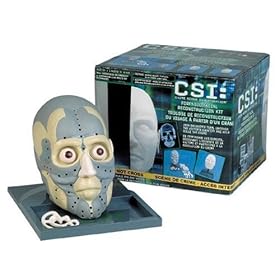
The CSI franchise appears to have a virtual empire of fun lab-related sets, from the CSI Fieldkit, which "comes with a fold-open box containing fingerprinting brushes and colored powder, crime tape, gloves, glasses, crimescope, mini microscope, tweezers, evidence containers, data journal, binoculars, spray bottle, camera, and more" (although apparently not luminol, alas), to the incredibly awesome looking CS Facial Reconstruction Kit, pictured to the left. And of course, no crime lab would be complete without a DNA Lab. "The kit offers instructions for conducting 10 experiments and provides little scientists with a working centrifuge, an electrophoresis chamber, and a three-speed motorized lab unit to carry out the work."

If the creative mind you're thinking about tends more towards Harry Potter than crime scenes, you're covered there, too. Again, there are quite a few options, but this one stood out for me: the Spells and Potions Science, Chemistry, Physics and Hobby Crafts set. Why not? If we can teach philosophy using pop culture, why can't we teach physics with Harry Potter? I think it's a brilliant idea.

Of course, the other great thing about this is the potential for DIY Biotech - as the processes and chemicals become cheaper and more foolproof, not only do non-professionals and kids have a chance to play and learn, but people who want to experiment and step outside the norm can do things like make art, grow their own skin, or - really, I think the limits are simply your own mind.

I find this incredibly exciting - and really wish I was 10 again!
-Kelly

*Boys, too. But I know I was always the envy of the other girls in my class, just because I had a father who did buy me science kits, let me build computers, have toy microscopes - does anyone else remember those? - and other things that are "typically" considered boy gifts.