It's too bad there's not a way to easily track the increase in call volume at fertility clinics. I'd give a lot to see what the call activity looked like this morning, after folks saw last night's episode ("In Which Dell Finds His Fight") of ABC's spin-off of Grey's Anatomy, Private Practice.
One of the two medical story lines followed in this episode centered on a couple who wanted to conceive, but the husband was diagnosed with azoospermia. The couple rapidly - as in, immediately after receiving the diagnosis - rule out adoption and decide that, since the wife is currently ovulating, they will try for sperm donation immediately.
Let's pause for a moment to consider the likelihood of a private practice based ob/gyn/fertility specialist and fetal surgeon/genetics specialist (we could really stop that sentence right there, but...) going from delivering a diagnosis of infertility to, within minutes, agreeing to allow the couple to select a sperm donor for insemination that day. I admit, this isn't my area of specialty, but I would think that this might be a process that takes time. Certainly more than the span of a few minutes.
However, that in and of itself, while rapidly paced and smoothed over for dramatic license, wasn't terribly egregious. It's the next part, where they opted not for sperm donation, but advanced sperm removal and IVF, that took the show beyond dramatic license and into the realm of "creating headaches for fertility clinics nationwide."
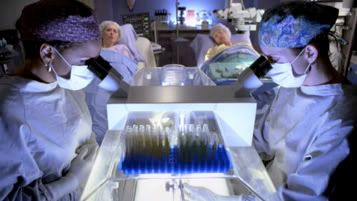
The two doctors explain to the couple that they can do a procedure called microsurgical retrieval of epididymal sperm, or MESA, and then extract the currently ovulating ovum from the wife, and use intracytoplasmic sperm injection (ICSI) to create a viable fetus, which was then immediately placed back into the uterus. The picture above is from this scene; you'll see that the patients were there and talking to the doctors as they performed this several stage complicated procedure all by themselves.
One of the things being talked about is just how real all this medicine was, and from what I saw and know (please correct what I get wrong), the procedures are all actually sound. It's the speed, the setting, and the overall depiction of the entire process that I find problematic. It's one thing to accelerate, for dramatic license, multiple office visits to discuss sperm donation and the details that would make, frankly, for boring television. No one wants to watch people sitting around talking, and it seems that the general knowledge level is such that no one expects to walk in to a fertility specialist office for a first visit, and walk out a hour later with sperm floating in their uterus.
MESA and ICSI are much more obscure, new, and not known procedures. By depicting them as joint events that can be simultaneously with single egg extraction during ovulation, and as something that takes no longer than an office visit instead of a several day if not weeklong or so process, gives an awful lot of false information that specialists then have to work at undoing. It's no longer a matter of educating a patient on a procedure, it's about undoing the subtle information bias that they might not even realize they hold.
Is it irresponsible for a show to compress and simplify a complicated procedure or concept so that it fits into the time allowed for the story? Maybe not, we expect dramatic license when we watch fictional television. The problem is just the degree of license - when you're going out of your way to establish authenticity with realistic imagery and dialogue, and strive for medical accuracy, it seems that putting a limit on just how far you stretch reality has to come in to play, as well.
-Kelly


