Showing posts with label STDs. Show all posts

Tuesday, March 18, 2008

A Quarter of Teenage Girls Test Positive For STDs

I'm just going to sit here and sip my coffee and let that title, and that statistic, sink in for a moment. A quarter of teenage girls test positive for sexually transmitted diseases. Go ahead and ponder it, I'll be here when you're done. Surely, you're thinking, it's not that bad! This must be sensationalistic reporting, or perhaps a matter of mistaking statistics or numbers or...

Okay, I admit. I stretched the truth a smidge to get the alarming title. In reality, the first national study of four common sexually transmitted diseases (chlamydia, HPV, trichomoniasis, and genital herpes) found that one in four teenage girls are infected with at least one of these diseases.

Oh. Clarifying that didn't really make it any better, did it?

Let's look at the numbers before we talk further, shall we? Always good to have those in front of us, whenever talking about straight up statistical analysis. According to the New York Times,
838 participants in the study were chosen at random with standard statistical techniques. Of the women asked, 96 percent agreed to submit vaginal swabs for testing. Extrapolating from the findings, 3.2 million teenage women were infected with at least one of the four diseases [emphasis added]. Because the new survey was based on direct testing, it was more reliable than analyses derived from data that doctors and clinics sent to the diseases center through state and local health departments.

To say that this suggests abstinence-only education is a complete and utter failure is, I think, a healthy understatement at best. And the numbers suggest something else, as well: abstinence-only education also hits minority communities harder, doing more damage, than the white communities. In this particular study, nearly half of the 14-19 year old black women had at least one of the four STDs being looked at, while only 20% of the white girls were similarly infected. Among these infected women, nearly 15% had multiple infections - of these four. Who knows what other infections were also piggybacked on top of the rest.

And of course, these infections all have the ability to present invisibly, for both men and women, meaning that not only is there a potential for continued widespread infection, but that it's very likely both women and men will end up with fertility problems down the line, thanks to the scarring that these diseases can cause (especially when they shift into pelvic inflammatory disease).

I'm not sure how people can look at these numbers and see anything other than earthshattering disaster for abstinence-only education. Something like a billion dollars has been spent on something that conclusively does not work. Not only does it not work, it is putting our teens, our children, at serious and significant health risk, not only for the immediate but for their future health, as well.

I've taught sex ed, and I know it can be uncomfortable. I've had to teach sex ed to my relatives, so I know how that can be even worse than sitting down with strangers. It can be embarrassing. Questions can be asked that you don't want to answer, or don't know how to answer - but we, socially, culturally, religiously, politically, need to get over it. Comprehensive sexuality education doesn't have to be about giving permission to have sex whenever; it's very much a whole body/being approach to teaching that doesn't just emphasize safe sex, but it also can (and should) emphasize things like waiting for what is morally right for the individual, cover things like protecting yourself from abuse, being comfortable in your own gendered skin, taking care of your plumbing; comprehensive sex ed is not about encouraging orgies, it's about encouraging responsibility and agency. We have to embrace this - and if we don't, then as a society, those infections are just as much our responsibility as it is the teenagers actually having the sex.

-Kelly


Oh, as a side note: the researchers in this particular situation did something I'd really love to see more often. While the survey was anonymous and they have no way of knowing which women were infected, they did inform all participants of the finding results and treatment recommendations via a password protected phone number, and they sent multiple reminders to the women who did not call in to the line. This keeps confidentiality, while still going well above and beyond what most researchers seem to do in these situations - it would be great if this could become the norm, rather than a pleasant surprise in a completely depressing article.

Wednesday, March 12, 2008

Governor Spitzer--in this Blog?

While the current political trials of Governor Spitzer may at first appear to have no place in this Blog, a small item in the news, which is being discussed in the Feminist Law Professors Blog, caught my eye as well. Apparantly one of things caught on tape is a conversation with the woman, "Kristen", who met with Client 9--allegedly Gov. Spitzer. The New York Times reports that "After her encounter with Client 9, the prostitute told the booker for the agency that it had gone well, and the booker told her that he, in an apparent reference to Client 9, sometimes asked the women “to do things that, like, you might not think were safe.” (Link here)


While this could mean many things, it most likely means he didn't want to wear a condom. As a result, he exposed Kristen, and any other women he slept with, to the full range of STI's (including HIV and HPV) as well as unwanted pregnancy. In an interesting example of perhaps unintended coordination, another story on the NY Times' front page reports a study that 25% of U.S. teenagers (including 50% of African American teenagers) test positive for sex infections which is leading to the conclusion that treatment of boys (including vaccination against HPV) and men must be part of an effective public health strategy.

I do not believe that prostitution should be legalized. However, if there are situations where it is a transaction between consenting adults, and therefore ethically unobjectionable, there is no information here that indicates this is one of those situations. First, we only assume that Kristen is a U.S. citizen who can voluntarily leave this line of work. This is often untrue of sex workers in the U.S. There are increasing reports of foreign women lured to this country with the promise of jobs and then finding themselves forced to be sex workers. Moreover, the link between prostitution and drug addiction has been shown again and again. Is this a sound foundation for informed consent?

Moreover, whether or not it would ever be ethical to allow a sex worker to consent to exposure to an STI could there ever be informed consent by the spouse, or other partners, of a man who engages in this high risk behavior without her knowledge? (and all arguments hold the same however you would like to shuffle around the genders of the parties involved--there is quite a bit of male prostitution and it carries with it the same stigma of STI's and drug addiction).

Prostitution is a health risk for everyone, especially women, and just as we have ethical limits on the risks any individual can take, whether in the context of a drug trial or a risky surgery, we must consider them when the danger is not just to an individual woman who may or may not have consented but to all women who sleep with people who sleep with sex workers.
So is there a link between Governor Spitzer and women's bioethics? Absolutely there is and to the best of our knowledge, her name is Kristen.

Thursday, December 20, 2007

FDA to require contraceptives to contain new warnings

According to a press release issued today, the FDA is requiring a new warning on all over the counter stand-alone vaginal contraceptive and spermicidal products. This warning is to inform the public that the spermicide nonoxynol 9 doesn't prevent the spread of sexually transmitted diseases, including HIV.

While this, on the one hand, makes sense - the clinical studies in Africa and Thailand that the press release refers to did show that nonoxynol 9 can irritate mucus membranes, actually increasing the risk for a variety of infections. But on the other hand, do people actually commonly believe, again as the press release suggests, that nonoxynol 9 is an effective barrier against STDs? They very clearly are a contraception, but doesn't our STD education - or even separate HIV education - explain the concept of bodily fluids transmitting infection?

So I admit that while I am neutral on the new packaging (I don't have a lot of faith that people read the directions and warnings in any great detail), I'm sort of baffled with its justification.
-Kelly

Wednesday, December 12, 2007

Is prettiness your best standard?

There is a pretty spirited debate about male circumcision going on at a NYT blog.

This was partially inspired by a recent blog post supporting female genital mutilation.

Your opinion on whether these are reasonably comparable issues will depend on your moral/ethical framework - comparative harms, consent, cultural relativism, aesthetics, etc. Personally, I subscribe to consent as the paramount value in this situation up until urgent, life-threatening conditions require immediate action. The supposed benefits in STI prevention are not compelling enough to me to justify permanent prophylactic removal of a part of an organ, and the aesthetic concerns expressed by people (especially women) are downright appalling.

One thing I do find interesting is that nary an anti-HPV-vaccination brawler has made a move to oppose circumcision because of the purported benefits in preventing STI transmission. If it is a priority to prevent our girls from turning into wanton harlots because of a vaccine against one STI given at a young age, shouldn't we also be concerned about our boys turning into the same thanks to the magical disease-defying benefits of circumcision, provided at *gasp* infancy?

Tuesday, December 11, 2007

fast followups

Two quick follow-ups on recent blog posts.

First, a federal judge has thrown out a lawsuit against the Albany, VA, a story Linda originally blogged about yesterday. The widows will have 30 days to decide if they want to appeal.

Secondly, if the spray-on condom story caught your eye, you can head over to this blog, which has arranged an interview with the inventor. Alternatively, you can just watch the below YouTube video of CSI: NY, which demonstrates how a spray can (versus "car wash") style application might work. As we discussed in the comments on that thread, this particular method of application is an interesting idea for covering areas of the genitalia not typically covered by condoms. (For example, I wonder if it could provide protection against something like HPV or herpes, while still allowing a couple to attempt conception without infection?)

Monday, December 10, 2007

spray on condoms

Do you ever find yourself watching a television show, or movie, and having to hit pause to Google something you saw, because you just can't quite believe it? In this particular instance, I'm catching up on episodes of CSI: NY, and in the first episode of season four, they begin talking about (and demonstrating) spray on condoms.
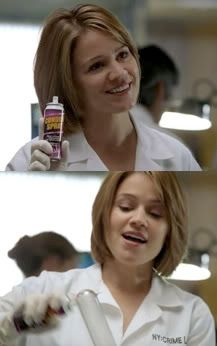
"No way!" I thought, sure that this was something I could laugh off as improbable. Liquid latex in a spray can, spray application, 5 second drying time? Pause, Firefox, Google. See! Complete fict- what? Real? Oh. ...oh?

It would seem I slept through this particular bit of 2006 science innovation.

In reality, it's not necessarily what CSI: NY showed; it's more of a slide on device that coats the penis evenly with spray nozzles (most news coverage refers to it as "car wash like", a description I'm just going to leave alone) that a latex condom version of hairspray, and marketing is targeted towards a custom fit that will help prevent slippage and breaking.

You can watch a video clip showing the prototype, how the latex dries, and a short interview at this link, but please be aware that the link is not necessarily safe for work, and contains references to other videos and stories of sexual activity that certainly runs the risk of offending.

Of course, assuming this makes it to market (some time in 2008, according to the manufacturing company), you've got to wonder if anyone would really use it. And is it actually a better "fit"? Is the lack of reservoir tip going to create problems? How is it different from liquid latex? What safety mechanisms are built in to ensure that it's an even coat, and not patchy, thin, or missing a spot here and there? Is it cost effective?

I can certainly see having a can of aerosolized liquid latex being fun - I'm the type of person who would promptly run around and try coating everything I could with it, just to see what would happen (especially if it could at all be used in practical jokes, like covering someone's sandwich unnoticed), but I'm having a hard time seeing its actual benefit for protection during sexual activity. It seems like it would be a type of bragging ("oh, I can't wear regular condom sizes...") or a gadget-y purpose of (in)conspicuous consumption.

Thoughts?
-Kelly