Showing posts with label tainted medications. Show all posts

Thursday, May 29, 2008

Ethics of Branded vs. Generic Drugs

On May 15, 2008, an article in the Wall Street Journal reported that a United States appeals court upheld a lower-court ruling striking down patents for Lovenox, an anticoagulant manufactured by Sanofi-Aventis. This may clear the way for generic competition.

When a pharmaceutical company discovers or develops a promising new compound, they apply for and receive patent approval, which provides for 17 years of patent protection and exclusivity. This gives them the sole right to sell the drug while the patent is in effect. However, as the patent nears expiration, other pharmaceutical companies are able to applications to the Food and Drug Administration to obtain approval to market generic versions of the brand-name drug.

The pharmaceutical companies claim that the period of market exclusivity enables them to recoup the cost of developing the new drug. However, pharmaceutical companies often try to extend the period of exclusivity by obtaining approval for their own generic version of the branded drug, which provides an additional 6-month marketing exclusitivity period. Also, they may try to obtain an extension on exclusivity by targeting special populations such as children.

The ethical dilemma raised here is how this marketing exclusivity for the pharmaceutical company affects the patients, those individuals with medical condition who need the drug. The availability of generic equivalents for brand-name drugs makes it easier for patients with low incomes or no health insurance to get the medications that they need. Very often, brand-name drugs are priced well beyond their means.

My mother had deep vein thrombosis and a pulmonary embolism 7 years ago and consequently has been on daily anticoagulation therapy ever since. She is at high risk for having another pulmonary embolism and approximately 30% of people who have pulmonary emboli die. When she was recently scheduled to have a hysterectomy, her hematologist recommended that she transition to Lovenox (enoxaparin, Sanofi-Aventis) during the week before her surgery and the week after the surgery. Subcutaneous Lovenox has a much shorter onset of action and half-life (12 hours) compared with the oral anticoagulant warfarin (4 to 5 days). So, this would enable her to receive anticoagulation therapy up to 12 hours before her surgery and again within 2 days after the surgery, reducing the amount of time that she'd be at risk for developing deep vein thrombosis or pulmonary embolism.

The real surprise came when my mother tried to fill her prescription for Lovenox. She is retired, but she does have prescription drug coverage. However, her co-payment for a 10-day supply of Lovenox injections was $900. That's right, $900. The insurance company was also paying $900. It turns out that Sanofi-Aventis does provide assistance for some patients who are unable to afford needed medication. However, when I downloaded the forms and helped my mother complete them, it turned out that her annual income was $1500 too much to qualify for assistance. So, she had to pay the $900 for the Lovenox. In her case, the risk was too great to go without the medication. However, now that she's had the surgery, she doesn't know how she's going to manage to pay her co-payment for all of the other related expenses--the hospital, the surgeon, the operating room, the anesthesiologist. She hadn't expected one medication to take all the money that she'd been setting aside in preparation for the surgery expenses.

So, I was pleased to read the news article about Sanofi-Aventis and to learn that generic versions of Lovenox might soon be available. Lower-priced generics will make it easier for patients like my mother to obtain the medication that they need for anticoagulation.
Hopefully, fewer patients will have to take pause to consider whether or not the risk of dying is worth the price of the drug.

Thursday, March 20, 2008

Tainted Drugs

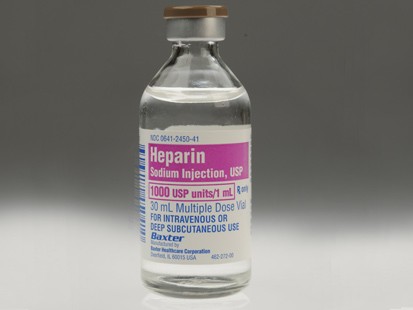
For the sake of people susceptible to earworms everywhere, I won't actually parody the Soft Cell song further than using it as a title here. And as alliterative and 80s-referential as the title is, it's also accurate: in recent weeks, almost two dozen people have died, and their deaths have been linked to contaminated heparin. This morning, the contamination (hypersulfated chondroitin sulfate) was announced, as was the fact that the contamination happened somewhere in China. Because hypersulfated chondroitin sulfate mimics heparin in standard safety tests, it looks likely that the contamination was intentional, likely done by someone trying to either cut costs or boost profits somewhere along the production line.

Congress is, of course, clamouring for action, and the FDA is defending itself, saying it's chronically undermanned and cannot realistically fulfill its broadranging mandate. The same exact reactions we saw in 1999, when contaminated antibiotics from China were linked to almost as many deaths. And since then, China has grown in exports, while the FDA has remained virtually stagnant in the number of inspections; latest numbers indicate the US imports almost a quarter of its medications from China, and only 6% are inspected by the FDA.

With this latest tainted drugs scandal, the Senate has passed a 20% increase in budget for the FDA, but realistically, when the FDA is admitting that they are violating their own policies, suffering from poor management, and whatever other excuse it can pull out of its hat'o'excuses, it seems likely that the additional $375 million is just going to be a bandaid over a much greater problem: the need to reorganize the FDA.

Connecticut Democratic Representative Rosa DeLauro joins me on the skeptic train, saying that she doesn't "want to throw money at an agency that doesn’t have the infrastructure to carry out its mission.” Going a step further than I've actually said, she also notes that top agency officials are incompetent, and the only way any genuine change will happen is a completely new administration for the agency.

News of contaminants from China is not new - this time around, it was heparin. It's been antibiotics in the past. A year ago, dozens of people lost beloved pets to contaminated pet food. Our children's toys have been recalled because of lead and other contaminants. There are two trends here, that cannot be ignored: the FDA is unable to protect the American public, and there is rampant and dangerous corruption in China that does more than just hurt its own population, it affects us all. We, as a people, need to step up and stop accepting the excuses of the FDA and demand reform - and we need to demand a very different sort of relationship with China and the goods we import from them.
-Kelly

Thursday, January 31, 2008

Tainted Drugs*

A state-owned Chinese pharmaceutical company is at the heart of an international drug scandal after it's been revealed that over 200 patients were paralyzed or otherwise hurt by tainted leukemia drugs last summer. But in what we sometimes cynical Westerner's might consider a surprise, given recent cover-up history (especially regarding lead in toys), China's Food and Drug Administration has been at the heart of chasing down the pharma company managers, and responsible for closing the plant when the tainted drugs were discovered.

This would be alarming news to receive about any major pharma company, regardless of their involvement in the import/export industry, but the fact that Shanghai Hualian is the sole supplier of mifepristone (RU-486) for the United States raises even bigger concerns.

So far, the contaminated medications have been isolated to a factory about an hour away from the one that makes RU-486, but obviously when a company has one manufactoring problem, concern spreads to the entire system.

The United States Food and Drug Administration declined to answer questions about Shanghai Hualian, because of security concerns stemming from the sometimes violent opposition to abortion. But in a statement, the agency said the RU-486 plant had passed an F.D.A. inspection in May. “F.D.A. is not aware of any evidence to suggest the issue that occurred at the leukemia drug facility is linked in any way with the facility that manufactures the mifepristone,” the statement said.

When told of Shanghai Hualian’s troubles, Dr. Sidney M. Wolfe, a leading consumer advocate and frequent F.D.A. critic, said American regulators ought to be concerned because of accusations that serious health risks had been covered up there. “Every one of these plants should be immediately inspected,” he said.

The director of the Chinese F.D.A.’s drug safety control unit in Shanghai, Zhou Qun, said her agency had inspected the factory that produced mifepristone three times in recent months and found it in compliance. “It is natural to worry,” Ms. Zhou said, “but these two plants are in two different places and have different quality-assurance people.”


And while I do see this point, and agree with it to a degree, but given recent concerns both about the FDA and it's process, as well as China covering up manufacturing and health issues... I would certainly feel a lot better if the FDA released something more concrete than a no comment. That the FDA won't reveal what other medications are made/imported by the company also is worrisome. Again, on the one hand, I can understand not wanting to run consumers off by fear - but on the other hand, a lot of pets died because of contaminated food. Do we want to see the same health risks in our medications?

-Kelly

(*And as an aside, apologies to anyone else who now has Soft Cell's Tainted Love spinning 'right round in their head.)
-Kelly