Tonight at 9pm, Hallmark is airing the original movie "Sweet Nothing in My Ear". Before you decide to lynch me, hear me out: the movie is about a married couple, one hearing and one Deaf, who have to decide whether or not their deaf child should receive a cochlear implant. Director Joseph Sargent has a history of working with Deaf actors and making movies that are considered accurate and respectful towards the Deaf point of view, and the cast is full of both Deaf and hearing actors, including Marlee Matlin in her first full ASL-only role since "Children of a Lesser God."
At its heart, this story is one of medical debate: is hearing the norm? Is a lack of hearing a handicap that needs to be fixed? Or is it just a part of life, a condition to be accepted and dealt with and moved on from?
I know this is a subject that gets a lot of commentary around here, which is why I'm mentioning the movie being on this evening. Given I'm in the finals crunch, I probably won't have time to watch and/or comment on the movie for a few days, but did assume others here would likely be interested - both in the subject matter, and how ethical dilemmas are played out on television.
-Kelly Hills
Showing posts with label Media. Show all posts
Showing posts with label Media. Show all posts
Sunday, April 20, 2008


Wednesday, April 09, 2008
Cake or Rape? Not the Same Ring as Cake or Death...
 When people hear that I write for this blog, they almost immediately ask why it's necessary to have a women's bioethics blog - what's the point to having something written primarily for women, by women, about issues that affect women? Haven't we moved beyond and to a point where gender shouldn't matter, we're enlightened enough, and so forth? I try to take it as a good thing, that people want to think this, while simultaneously think that some things are so set into society that people don't even see why it would be necessary.
Stories like this, however, are why I think it's important that women's views are heard, loud and strong. There are so many things wrong with the following statement, starting with someone feeling like it was an acceptable comparison to make, moving into the problems rape victims face, gender imbalance and expectations in marriage, the undermining of the concept of consent - it goes on, and on. Is it strictly related to bioethics? Not necessarily, although I think it's possible to create very solid, bioethical related arguments around and against rape. Is it an attitude we should all be aware is still out there? Most certainly. From the Londonist:
The BNP’s Nick Eriksen learnt this the hard way last week, after he was sacked as the party's London Assembly candidate for publishing jaw-droppingly obtuse views on rape on his blog. The post has since been removed, but luckily journalists were quick to spot the following:When our elected officials (and I use our on a global scale) harbour these views towards women, then it's likely that they're not going to be the advocates for women's rights, health, and etc."Rape is simply sex (I am talking about 'husband-rape' here)... Women enjoy sex, so rape cannot be such a terrible physical ordeal…To suggest that rape, when conducted without violence, is a serious crime is like suggesting force-feeding a woman chocolate cake is a heinous offence.”
-Kelly Hills
Monday, March 31, 2008
Pew: State of the Media released
Pew's 2008 State of the Media has been released, and while I haven't had time to read much of the report yet, Framing Science has a fascinating and sad breakdown of cable news topic coverage that adds a new element to the discussion Sue and I have been having about illustrating and popularizing science.
-Kelly
Collectively, the broad range of domestic issues including the environment, education, transportation, development, religion, domestic terrorism, health care, race -- everything but immigration -- made up 13% of the time on cable (compared with 26% on network evening news). The three topics of celebrity, crime and disasters, in contrast, accounted for 24% of cable's time.While my initial reaction is "well, who cares about illustrating the story when the signal is getting lost in the noise", my second reaction is to wonder if again, we're seeing a lack of content because the media types don't know how to report it. Is it a matter of lack of education, lack of visuals, lack of knowledge, or (what I fear) lack of interest?
To put that into perspective, if one were to have watched five hours of cable news, one would have seen about:
* 35 minutes about campaigns and elections
* 36 minutes about the debate over U.S. foreign policy
* 26 minutes or more of crime
* 12 minutes of accidents and disasters
* 10 minutes of celebrity and entertainment
On the other hand, one would have seen:
* 1 minute and 25 seconds about the environment
* 1 minute and 22 seconds about education
* 1 minute about science and technology
* 3 minutes and 34 seconds about the economy
* 3 minutes and 46 seconds about health and health care
-Kelly
Friday, March 21, 2008
Synecdoche, New York
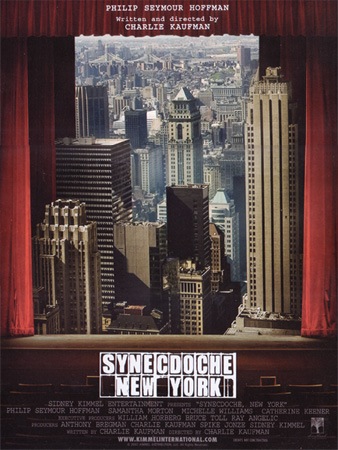 Few film writers get quite the reaction, at least from my community of peers (philosophers and bioethicists) as Charlie Kaufman. There's probably no small irony in the fact that media-focused me had actually seen none of his movies. Even then, I know that they're an impressive list: Being John Malkovich, Human Nature, Adaptation, Confessions of a Dangerous Mind, Eternal Sunshine of the Spotless Mind. Most of these are loved and beloved by philosophers who deconstruct everything they watch, and have found their way into most friends' classrooms. (I know this because when I mention my interest in how we use media to teach, they inevitably will mention showing one of these films, or GATTACA.) His movies almost always deal with neuro-something, be it neuroscience, exceptionalism, fiction, fantasy or fact. His newest movie, Synecdoche, New York, is no exception.
 The incredibly detailed imdb profile for the movie tells us
Theater director Caden Cotard (Philip Seymour Hoffman) is mounting a new play. Fresh off of a successful production of Death of a Salesman, he has traded in the suburban blue-hairs and regional theater of Schenectady for the cultured audiences and bright footlights of Broadway. Armed with a MacArthur grant and determined to create a piece of brutal realism and honesty, something into which he can put his whole self, he gathers an ensemble cast into a warehouse in Manhattan's theater district. He directs them in a celebration of the mundane, instructing each to live out their constructed lives in a small mockup of the city outside. As the city inside the warehouse grows, Caden's own life veers wildly off the tracks. The shadow of his ex-wife Adele (Catherine Keener), a celebrated painter who left him years ago for Germany's art scene, sneers at him from every corner. Somewhere in Berlin, his daughter Olive is growing up under the questionable guidance of Adele's friend, Maria (Jennifer Jason Leigh). He's helplessly driving his marriage to actress Claire (Michelle Williams) into the ground. Sammy Barnathan (Tom Noonan), the actor Caden has hired to play himself within the play, is a bit too perfect for the part, and is making it difficult for Caden to revive his relationship with the alluringly candid Hazel (Samantha Morton). Meanwhile, his therapist, Madeline Gravis (Hope Davis), is better at plugging her best-seller than she is at counseling him. His is second daughter, Ariel, is retarded. And a mysterious condition is systematically shutting down each of his autonomic functions, one by one. As the years rapidly pass, Caden buries himself deeper into his masterpiece. Populating the cast and crew with doppelgangers, he steadily blurs the line between the world of the play and that of his own deteriorating reality. As he pushes the limits of his relationships, both personally and professionally, a change in creative direction arrives in Millicent Weems, a celebrated theater actress who may offer Caden the break he needs. By seamlessly blending together subjective point-of-views with traditional narrative structures, writer/director Charlie Kaufman has created a world of superbly unsteady footing. His richly developed cast of characters flutter between moments of warm intimacy and frightful insecurity, creating a script that brings to life all the complex and beautiful nuances of shared life and artistic creation. Synecdoche, New York is as its definition states: a part of the whole or the whole used for the part, the general for the specific, the specific for the general.It sounds like, in addition to the continual theme in his movies of places becoming states of (altered) mind, Kaufman can add neurotourism to the list of neuro-concepts at the core of his movies.
From all descriptions, this sounds like another movie that will make many people's teaching arsenal, so it should be interesting to see what the reaction is when it comes out. I haven't seen a release date yet, just "2008", but I suspect we should be seeing it soon (those of us living in the Capital Region of New York State sooner than most, perhaps, given that the movie starts out set in local city Schenectady). Someone go see this, will ya, and let us know how it is? (I'd offer, but I'm the first to admit my movie-going habits are awful.)
-Kelly
Wednesday, February 20, 2008
Bioethics and "The Island"
Like most of America, you probably haven't seen Michael Bay's The Island (2005), starting Ewan McGregor and Scarlett Johansson. It's not a cinematographic masterpiece. It is downright goofy in spots, there is a lot of stuff blowing up (this is the team that brought us Transformers and Armageddon, after all), and it has the most intrusive product placement I've ever seen in a movie. But if you're interested in bioethics, and particularly if you're interested in how the mass media depicts biotech, you should get your hands on the DVD. If you teach bioethics, the film could provide a nice springboard for discussion. Plus, for the first third or so, it's got Steve Buscemi, which is always a plus in my book.
The film is set in the not-too-far-distant future, in a prisonlike facility that (we are told) is one of only two safe places left on the planet following The Contamination. It's a highly regulated environment, in which individuals' sleep, diet, and bodily functions are monitored 24x7. "Proximity rules"--men and women aren't allowed to get too close--and other regulations are enforced by omnipresent security guards. The other safe place on the planet is The Island--a beautiful tropical paradise that has somehow escaped contagion. It is the dream of everyone in the place to go there. The only way to get a ticket is to win the lottery.
Our hero, Lincoln Six-Echo, is a nonconformist in an environment that requires absolute compliance. He breaks out of the facility, briefly, only to discover the truth: he and his compatriots are being used as biological raw materials -- "insurance policies" -- for the rich and famous in the outside (uncontaminated!) world. The supposed lottery "winners" aren't really winners after all. You can imagine, probably, how the action bits of the story unfold from this point.
There are lots and lots of interesting themes at work here, among them:
The film is set in the not-too-far-distant future, in a prisonlike facility that (we are told) is one of only two safe places left on the planet following The Contamination. It's a highly regulated environment, in which individuals' sleep, diet, and bodily functions are monitored 24x7. "Proximity rules"--men and women aren't allowed to get too close--and other regulations are enforced by omnipresent security guards. The other safe place on the planet is The Island--a beautiful tropical paradise that has somehow escaped contagion. It is the dream of everyone in the place to go there. The only way to get a ticket is to win the lottery.
Our hero, Lincoln Six-Echo, is a nonconformist in an environment that requires absolute compliance. He breaks out of the facility, briefly, only to discover the truth: he and his compatriots are being used as biological raw materials -- "insurance policies" -- for the rich and famous in the outside (uncontaminated!) world. The supposed lottery "winners" aren't really winners after all. You can imagine, probably, how the action bits of the story unfold from this point.
There are lots and lots of interesting themes at work here, among them:
- The use of a public-health threat to control a population
- The creation of clones to serve as a source of transplant organs
- The creation of clones to serve as gestational carriers
- What makes clones different from humans (if anything), and what makes humans "persons" (in the philosophical sense of "one of us")--there is a great scene in which Steve Buscemi tries to explain to McGregor and Johansson that they're not like him
- The role of medical personnel in this operation--should physicians and nurses participate in this kind of thing?
- How language frames our ability to discern right from wrong (to their creators and their customers, the clones are "insurance policies," "products," or "Agnates"--not clones, not individuals, and certainly not people)
- How visual images shape our ethical intuitions--some very graphic depictions of how the clones develop and are "extracted," how they are treated by medical professionals and guards
- What it might mean that this film was released in 2005, as the stem-cell debate was heating up in the US
- Clones as human chattel, and connections with slavery (or sex trafficking, though the latter is not part of the film)
Tuesday, January 29, 2008
Fiction or...?
 As I'm sure most of the regular blog readers have realized, I'm a fan of pop culture. I'm endlessly fascinated with the media and how it spreads knowledge - or misinformation.
 The new ABC show Eli Stone, which I have quite been looking forward to - the premiere has George Michael as prophet singing Faith - is by the same producer who's given us Brothers & Sisters and Dirty Sexy Money. So I was thinking "how in the world could this go wrong, it'll be fabulous!"
Well, apparently the world likes to make a point sometimes. The American Academy of Pediatrics wants the first show either pulled or substantially re-edited, because the opening scene involves a woman suing a pharmaceutical company over the supposed autism/vaccine link, saying that it's the reason her child is autistic. The link we know doesn't exist. Where the lead researcher involved was charged with misconduct in an effort to put the link/controversy to rest. The lawyers settle, after the woman makes your typical heartwarming by a wronged mother speech.
Given the description, you would think that the pharma companies would be going after ABC, but instead it's the pediatricians. They're worried that the heavy promotion ABC has been giving Eli Stone (a new show in a sea of repeats due to the writer's strike), and the likelihood of high viewership, will result in frightening more parents away from vaccinating.
The sad thing is, it's clear from the entire set-up that the scenario is supposed to make us dislike Eli, the main character, so that at his redemption we feel something for him. But it would have been completely possible to make him an utter bastard of a lawyer - and not propagate medical misinformation in the process.
 ABC's response, to run a website for the CDC at the end of the show, isn't going to alleviate fears - it's not even going to address them. It's the difference between using scare tactics to get a message across versus a mass mailed flyer. And ultimately, they're counting on popular misconception and fear to tell their story for them, which is plain lazy writing.
But don't take my word for it, make your own decision. You can see for yourself. The first seven minutes of the show are available at ABC. Just select Eli Stone from the left side menu, and then select the sneak peak episode.
-Kelly
Sunday, January 20, 2008
UCSF Scrambles to Undo Damage
As I wrote about earlier this week, UCSF researchers released a study linking a new drug-resistant strain of staph known as MRSA USA300 to the gay community, prompting worldwide headlines that read such 1980s flashback headlines as "FLESH-EATING BUG SPREADS AMONG GAYS" and "EPIDEMIC FEARED--GAYS MAY SPREAD DEADLY STAPH INFECTION TO GENERAL POPULATION". Aside from fueling general fears, the report (and headlines) gave ammunition to anti-gay groups like the Concerned Women of America, who used this latest research as a rallying point for their point of view that homosexuality is sexually deviant behaviour, and these infections are proof of it. And while conventional wisdom says everything becomes a fad 20 years after it was originally around, this is one particular period of the 80s I think we could all do without.
Anyhow, the UCSF researchers actually appeared to realize the damage done, and are waging a media war of their own to undo the inaccurate media reports, misconceptions of what their study said, and undermine groups who are trying to twist their study for other agendas. On Friday, the university and its researchers issued an apology, saying
What is interesting about this is the acknowledgment by Dr. Chambers that they did not think outside their own discipline when writing their report or releasing the study. While that limited view and hyper-focus was a common and accepted part of a pre-internet academic community, which relied on published journals to transmit information - guaranteeing that at least the media would have to wait to attempt to stir up sensationalist claims. These days of electronic media, however, lead to a situation of electronic publication of paper results, which is how the UCSF MRSA USA300 report was made public. With that comes instant reporting, instant response, and the emphasis moves away from accuracy and towards sensationalism, an effort to attract the viewer eye. How do you compete with that?
The answer, it seems, is simple. You play the same game. Instead of ignoring the potentials of the internet for rapid information dissemination, for instant response, you do what Dr. William H. Parker, clinical professor of obstetrics and gynecology at the University of California, Los Angeles School of Medicine did. You fight fire with fire, create your own email messages with accurate information you encourage people to forward on, and make sure when you release your research results to the public, you consider both your academic peers and the lay people who will see the research. This might mean writing a "dumbed down" or accessible version of your report for release to general media outlets - but isn't that preferable to having your research misinterpreted and misreported?
-Kelly
Anyhow, the UCSF researchers actually appeared to realize the damage done, and are waging a media war of their own to undo the inaccurate media reports, misconceptions of what their study said, and undermine groups who are trying to twist their study for other agendas. On Friday, the university and its researchers issued an apology, saying
their release had “contained some information that could be interpreted as misleading.”
“We deplore negative targeting of specific populations in association with MRSA infections or other public health concerns,” it concluded. Dr. Henry Chambers, one of the report’s authors and a professor of medicine at the university, said he was surprised by how the report had been spun.
“I think we were looking at this from a scientific point of view and not projecting any political impact,” he said. “We were focusing on the data. You want to make sure it’s as right as possible and written up in a form that reviewers would understand what you’re trying to say, and do it in a clear manner so it’s not subject to misinterpretation. Which is what happened later, it appears.”
What is interesting about this is the acknowledgment by Dr. Chambers that they did not think outside their own discipline when writing their report or releasing the study. While that limited view and hyper-focus was a common and accepted part of a pre-internet academic community, which relied on published journals to transmit information - guaranteeing that at least the media would have to wait to attempt to stir up sensationalist claims. These days of electronic media, however, lead to a situation of electronic publication of paper results, which is how the UCSF MRSA USA300 report was made public. With that comes instant reporting, instant response, and the emphasis moves away from accuracy and towards sensationalism, an effort to attract the viewer eye. How do you compete with that?
The answer, it seems, is simple. You play the same game. Instead of ignoring the potentials of the internet for rapid information dissemination, for instant response, you do what Dr. William H. Parker, clinical professor of obstetrics and gynecology at the University of California, Los Angeles School of Medicine did. You fight fire with fire, create your own email messages with accurate information you encourage people to forward on, and make sure when you release your research results to the public, you consider both your academic peers and the lay people who will see the research. This might mean writing a "dumbed down" or accessible version of your report for release to general media outlets - but isn't that preferable to having your research misinterpreted and misreported?
-Kelly
Monday, October 08, 2007
Medical Dramas- the New Reality TV?
We touched on this topic briefly during a class session, discussing the challenge involved in trying to provide accuracy as a knowledgeable professional, while dealing with television producers whose job it is to provide drama and excitement for the viewer. Often accuracy goes out the window. After 25 years of dealing with the same myself on the news side, I can relate personally.
This article, from Forbes.com, addresses the issue of how these programs frequently make mistakes in the information ultimately shared with viewers, despite their reliance on any number of experts and consultants there to provide accurate representations of diseases, and medical procedures. With a more sophisticated consumer/viewer, there's little concern that these shows are seen as nothing more than entertainment. However, a number of studies have published data that this perception may be far from reality.
It's no secret that many lay people get and rely more and more on information gleaned from popular media, and less from reliable sources. These studies, published in several scholarly journals, presented findings that showed viewer perceptions and beliefs about procedures such as cosmetic surgery, to organ donation, that were directly attributable to these programs.
So what do you think?
Is this unfolding trend the result of blatant disregard for the facts on the part of TV networks, who use creative license beyond its purpose--in other words taking entertainment too far--or are the studies over dramatizing the issue and "making something out of nothing"?
This article, from Forbes.com, addresses the issue of how these programs frequently make mistakes in the information ultimately shared with viewers, despite their reliance on any number of experts and consultants there to provide accurate representations of diseases, and medical procedures. With a more sophisticated consumer/viewer, there's little concern that these shows are seen as nothing more than entertainment. However, a number of studies have published data that this perception may be far from reality.
It's no secret that many lay people get and rely more and more on information gleaned from popular media, and less from reliable sources. These studies, published in several scholarly journals, presented findings that showed viewer perceptions and beliefs about procedures such as cosmetic surgery, to organ donation, that were directly attributable to these programs.
So what do you think?
Is this unfolding trend the result of blatant disregard for the facts on the part of TV networks, who use creative license beyond its purpose--in other words taking entertainment too far--or are the studies over dramatizing the issue and "making something out of nothing"?
Subscribe to:
Posts (Atom)


