There is a pretty spirited debate about male circumcision going on at a NYT blog.
This was partially inspired by a recent blog post supporting female genital mutilation.
Your opinion on whether these are reasonably comparable issues will depend on your moral/ethical framework - comparative harms, consent, cultural relativism, aesthetics, etc. Personally, I subscribe to consent as the paramount value in this situation up until urgent, life-threatening conditions require immediate action. The supposed benefits in STI prevention are not compelling enough to me to justify permanent prophylactic removal of a part of an organ, and the aesthetic concerns expressed by people (especially women) are downright appalling.
One thing I do find interesting is that nary an anti-HPV-vaccination brawler has made a move to oppose circumcision because of the purported benefits in preventing STI transmission. If it is a priority to prevent our girls from turning into wanton harlots because of a vaccine against one STI given at a young age, shouldn't we also be concerned about our boys turning into the same thanks to the magical disease-defying benefits of circumcision, provided at *gasp* infancy?
Wednesday, December 12, 2007


Study Finds Detecting Breast Cancer Depends on Radiologist
There is a new study on the effectiveness of diagnostic mammograms in actually detecting cancerous masses, and the news is sadly grim. Previous studies have shown substantial differences of opinion in radiologists when viewing screening mammograms (up to 25% of cases), but no one knew if this inaccuracy extended to diagnostic mammograms, situations where women have lumps or other symptoms.
The results are not good - radiologists miss an average of 2 in every 10 cases, with some missing as much as 7 out of every 10. The numbers, for those inclined, from the Chicago Tribune article (registration required), are:
 The results do suggest one clear thing: it's better to have your images read by someone who specializes in diagnostic breast imaging. The radiologists with the highest and most consistent correct reads were those in academic medical centers, and then those who spend at least 20% of their time on breast imaging. Unfortunately, most women in America have their images read by general radiologists in their community; in this study, 1/4 of those radiologists see less than 1,000 mammograms a year.
I haven't been able to access the article itself to read (but Andrea provided the link to the abstract, thanks!), but one other question does come strongly to mind. In the cases where the researchers found radiologists missing as many as 7 out of 10 cases of breast cancer, did the researchers say anything to the radiologists? To the center the radiologists work at? To someone, anyone? Did they track down those women with missed cancer cases who haven't already found out they were mis-diagnosed?
I realize this is a common question when it comes to research ethics, and perhaps my point of view is just too badly skewed by watching my mother die from cancer, but I can't imagine how you could know that people were out there without receiving treatment, going to die because of a missed diagnosis that you know about. And how can you not say anything about the person(s) continuing to risk lives by not being good at their jobs?
-Kelly
The results are not good - radiologists miss an average of 2 in every 10 cases, with some missing as much as 7 out of every 10. The numbers, for those inclined, from the Chicago Tribune article (registration required), are:
123 radiologists who interpreted nearly 36,000 diagnostic mammograms between 1996 and 2003 at 72 U.S. facilities. All the mammograms had been ordered for women who found a lump themselves or whose doctors discovered something of concern.This is kind of scary. These are women who already have cause to consider breast cancer a risk, be it lump or pain or leaking fluids, and they are still receiving false negatives. And given that the rate of breast cancer is 10fold higher among women with physical symptoms who go in for diagnostic (as opposed to screening) mammograms, you have to wonder how many women who receive those false negatives actually go and get a second opinion? How many primary care doctors insist on a second opinion, period, regardless of the result (but especially if the test result appears to disagree with physical symptoms)?
The researchers found that sensitivity—the ability to detect cancer when it's present—ranged from 27 percent to 100 percent, with a median of 79 percent. The false-positive rate—women who got a tentative diagnosis of cancer when they didn't have it—ranged from zero to 16 percent, with a median of 4.3 percent.
But even for radiologists at teaching hospitals, median sensitivity was only 88 percent, which means that on average 12 out of every 100 cases of breast cancer in symptomatic patients were not detected.
The results do suggest one clear thing: it's better to have your images read by someone who specializes in diagnostic breast imaging. The radiologists with the highest and most consistent correct reads were those in academic medical centers, and then those who spend at least 20% of their time on breast imaging. Unfortunately, most women in America have their images read by general radiologists in their community; in this study, 1/4 of those radiologists see less than 1,000 mammograms a year.I haven't been able to access the article itself to read (but Andrea provided the link to the abstract, thanks!), but one other question does come strongly to mind. In the cases where the researchers found radiologists missing as many as 7 out of 10 cases of breast cancer, did the researchers say anything to the radiologists? To the center the radiologists work at? To someone, anyone? Did they track down those women with missed cancer cases who haven't already found out they were mis-diagnosed?
I realize this is a common question when it comes to research ethics, and perhaps my point of view is just too badly skewed by watching my mother die from cancer, but I can't imagine how you could know that people were out there without receiving treatment, going to die because of a missed diagnosis that you know about. And how can you not say anything about the person(s) continuing to risk lives by not being good at their jobs?
-Kelly
Tuesday, December 11, 2007
fast followups
Two quick follow-ups on recent blog posts.
First, a federal judge has thrown out a lawsuit against the Albany, VA, a story Linda originally blogged about yesterday. The widows will have 30 days to decide if they want to appeal.
Secondly, if the spray-on condom story caught your eye, you can head over to this blog, which has arranged an interview with the inventor. Alternatively, you can just watch the below YouTube video of CSI: NY, which demonstrates how a spray can (versus "car wash") style application might work. As we discussed in the comments on that thread, this particular method of application is an interesting idea for covering areas of the genitalia not typically covered by condoms. (For example, I wonder if it could provide protection against something like HPV or herpes, while still allowing a couple to attempt conception without infection?)
First, a federal judge has thrown out a lawsuit against the Albany, VA, a story Linda originally blogged about yesterday. The widows will have 30 days to decide if they want to appeal.
Secondly, if the spray-on condom story caught your eye, you can head over to this blog, which has arranged an interview with the inventor. Alternatively, you can just watch the below YouTube video of CSI: NY, which demonstrates how a spray can (versus "car wash") style application might work. As we discussed in the comments on that thread, this particular method of application is an interesting idea for covering areas of the genitalia not typically covered by condoms. (For example, I wonder if it could provide protection against something like HPV or herpes, while still allowing a couple to attempt conception without infection?)
Birds Do It.... so do Chimps and Dolphins
 Display remarkable intelligence, that is...after spending all of yesterday discussing various aspects of personhood (from embryos to animals to artificial intelligence) at the Terasem conference, this article is timely in illustrating the evidence accumulating on animal intelligence:
'The chimp who outwits humans; the dolphin who says it with seaweed; the existential dog... An elephant that never forgets its extended family, a chimp that can
 outperform humans in a sophisticated test of visual memory and an amorous male dolphin that likes to say it with flowers -- well, a clump of river weeds to be more precise. These are just some of the recent observations from the field of animal behaviour. They appear to show that there is no limit to the intelligence of animals, but what do we really know about the true cognitive powers of the non-human brain?"
To read the rest of the article, click here. And to see a remarkable demonstration, click here.
South Korea Rethinks Asia's Preference for Sons
[Hat tip to Jay Hughes for this article]: We've blogged about the perils of sex selection and the predicament of fewer girls being born in Asian and Indian countries, but this article brings some hopeful news:
"In the early 1990s, among Korean women who had already borne two or more children, the sex imbalance was as high as 206 boys for every 100 girls. In those times, it was common for married Korean men to feel ashamed if they had no sons, some went so far as to divorce wives who did not bear boys." Full article here.
"In the early 1990s, among Korean women who had already borne two or more children, the sex imbalance was as high as 206 boys for every 100 girls. In those times, it was common for married Korean men to feel ashamed if they had no sons, some went so far as to divorce wives who did not bear boys." Full article here.
Monday, December 10, 2007
Healthcare for Veterans under scrutiny in NY -- the 'dark chapter'
The health care system under the Veterans Administration has been investigated and looked at by the bioethics community before, but according to the Times-Union , papers filed recently in a federal court in Albany detail a string of disturbing lapses at the VA Hospital in Albany. AMBI's Glenn McGee has been called as an expert witness and characterized the situation in the VA as a "systematic deception by clinicians in plain violation of medical and research ethics across 3,000 years of the development of such principals."
Ouch -- this is certainly not what our veterans deserve. To read the whole article, click here.
Ouch -- this is certainly not what our veterans deserve. To read the whole article, click here.
A New Angle on Dyslexia
New York Times reports that an unexpectedly high number of small business owners are dyslexic..
This reminds me of Dr. Robert Sapolsky's lecture on schizophrenia, schizotypalism, and obsessive-compulsive disorder where he suggested that people with such "abnormalities" were often able to find a place in a part of society where activities or traits associated with their "disorder" became assets. Speaking from my experience in the Navy, I could see hints at several personality subgroups in extremely high proportions who were either drawn to or retained by aspects of military service.
Perhaps in addition to seeking ways to "normalize" people clinically, we could also consider exploring activities or career paths that are not only forgiving, but highly compatible with a person's particular situation - a sociological solution to a clinical problem.
The report, compiled by Julie Logan, a professor of entrepreneurship at the Cass Business School in London, found that more than a third of the entrepreneurs she had surveyed — 35 percent — identified themselves as dyslexic. The study also concluded that dyslexics were more likely than nondyslexics to delegate authority, to excel in oral communication and problem solving and were twice as likely to own two or more businesses.
“We found that dyslexics who succeed had overcome an awful lot in their lives by developing compensatory skills,” Professor Logan said in an interview. “If you tell your friends and acquaintances that you plan to start a business, you’ll hear over and over, ‘It won’t work. It can’t be done.’ But dyslexics are extraordinarily creative about maneuvering their way around problems.”
This reminds me of Dr. Robert Sapolsky's lecture on schizophrenia, schizotypalism, and obsessive-compulsive disorder where he suggested that people with such "abnormalities" were often able to find a place in a part of society where activities or traits associated with their "disorder" became assets. Speaking from my experience in the Navy, I could see hints at several personality subgroups in extremely high proportions who were either drawn to or retained by aspects of military service.
Perhaps in addition to seeking ways to "normalize" people clinically, we could also consider exploring activities or career paths that are not only forgiving, but highly compatible with a person's particular situation - a sociological solution to a clinical problem.
spray on condoms
 Do you ever find yourself watching a television show, or movie, and having to hit pause to Google something you saw, because you just can't quite believe it? In this particular instance, I'm catching up on episodes of CSI: NY, and in the first episode of season four, they begin talking about (and demonstrating) spray on condoms.
"No way!" I thought, sure that this was something I could laugh off as improbable. Liquid latex in a spray can, spray application, 5 second drying time? Pause, Firefox, Google. See! Complete fict- what? Real? Oh. ...oh?
It would seem I slept through this particular bit of 2006 science innovation.
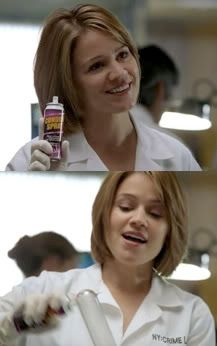 In reality, it's not necessarily what CSI: NY showed; it's more of a slide on device that coats the penis evenly with spray nozzles (most news coverage refers to it as "car wash like", a description I'm just going to leave alone) that a latex condom version of hairspray, and marketing is targeted towards a custom fit that will help prevent slippage and breaking.
You can watch a video clip showing the prototype, how the latex dries, and a short interview at this link, but please be aware that the link is not necessarily safe for work, and contains references to other videos and stories of sexual activity that certainly runs the risk of offending.
Of course, assuming this makes it to market (some time in 2008, according to the manufacturing company), you've got to wonder if anyone would really use it. And is it actually a better "fit"? Is the lack of reservoir tip going to create problems? How is it different from liquid latex? What safety mechanisms are built in to ensure that it's an even coat, and not patchy, thin, or missing a spot here and there? Is it cost effective?
I can certainly see having a can of aerosolized liquid latex being fun - I'm the type of person who would promptly run around and try coating everything I could with it, just to see what would happen (especially if it could at all be used in practical jokes, like covering someone's sandwich unnoticed), but I'm having a hard time seeing its actual benefit for protection during sexual activity. It seems like it would be a type of bragging ("oh, I can't wear regular condom sizes...") or a gadget-y purpose of (in)conspicuous consumption.
Thoughts?
-Kelly
Sunday, December 09, 2007
You Know You’re a Bioethicist When....
Along the lines of Jeff Foxworthy, Chicago bioethicist Timothy Murphy gave me permission to reprint this funny take on our profession :
You Know You’re a Bioethicist when:
*As you exercise on the treadmill, you wonder about the ethical, legal, and social effects of prolonging your own life.
*You meet an acquaintance in the supermarket. She asks after your mother who is in the hospital. You phrase your answer so as not to violate HIPAA standards.
*At a university banquet in your honor, you ask if the chicken has been genetically modified or been given genetically modified feed.
*The waiter at your local restaurant describes the fish of the day but forgets to mention that the recipe contains chervil. You decry the restaurant’s failure of informed consent.
*Your teenage daughter wants angel wing tattoos on her shoulder blades. Your teenage son wants scarified rings on his back. You suggest that they consider whether rule-utilitarianism, act utilitarianism, or preference utilitarianism will help them make better decisions about body modification.
*You see a pregnant neighbor and ask whether her child will be a boy, a girl, or a clone.
*A reporter calls to ask you about a breaking case you know nothing about, but you nevertheless express an opinion.
*Your spouse asks why you were later coming home last night than anticipated. You advise that you’ll have to get an ethics consultation before making any further statements.
*When arrested for driving under the influence, you breathe a sigh of relief that federal regulations prohibit most experimentation on prisoners.
*Someone at the White House asks you to serve on the President’s Council on Bioethics. You protest that you have no qualifications as a bioethicist. The President appoints you anyway.
Timothy F. Murphy
Chicago, November 2007
You Know You’re a Bioethicist when:
*As you exercise on the treadmill, you wonder about the ethical, legal, and social effects of prolonging your own life.
*You meet an acquaintance in the supermarket. She asks after your mother who is in the hospital. You phrase your answer so as not to violate HIPAA standards.
*At a university banquet in your honor, you ask if the chicken has been genetically modified or been given genetically modified feed.
*The waiter at your local restaurant describes the fish of the day but forgets to mention that the recipe contains chervil. You decry the restaurant’s failure of informed consent.
*Your teenage daughter wants angel wing tattoos on her shoulder blades. Your teenage son wants scarified rings on his back. You suggest that they consider whether rule-utilitarianism, act utilitarianism, or preference utilitarianism will help them make better decisions about body modification.
*You see a pregnant neighbor and ask whether her child will be a boy, a girl, or a clone.
*A reporter calls to ask you about a breaking case you know nothing about, but you nevertheless express an opinion.
*Your spouse asks why you were later coming home last night than anticipated. You advise that you’ll have to get an ethics consultation before making any further statements.
*When arrested for driving under the influence, you breathe a sigh of relief that federal regulations prohibit most experimentation on prisoners.
*Someone at the White House asks you to serve on the President’s Council on Bioethics. You protest that you have no qualifications as a bioethicist. The President appoints you anyway.
Timothy F. Murphy
Chicago, November 2007
Not Just a Price Increase: The Human Cost of Contraceptive Prices
After more than a decade of decreasing birth rates among teenagers, the birth rate among teenagers 15 to 19 in the United States rose for the first time since 1991, according to a recent report by the Centers for Disease Control. Births among teenagers tend to lead to poorer health outcomes for both the young mothers and their babies. Not surprisingly, the report further inflamed the already heated debate surrounding “abstinence only” versus “comprehensive” sex education and ignored crucial access issues. Sexually active women, especially young women, are at increasing risk for unintended pregnancy and unmarried pregnancy due to constricted access to effective contraception on a number of fronts. First, the increase in the number of states limiting teens’ access to confidential reproductive health services, legislating parental notification laws not only for abortion but also for contraception despite demonstrated reductions in teen pregnancy rates. Second, women’s and girls’ reproductive health is endangered by pharmacists’ refusals to fill legal prescriptions for emergency contraception and oral contraception, their refusals increasingly protected by so-called “conscience” legislation that sacrifices women’s and girls’ health to ideology. No lobby no presence. Third, the cost of contraception has increased beyond the means of college students. In July the Centers for Medicare and Medicaid issued regulations that remove the incentives for drug companies to provide deeply discounted prices to college health clinics; a one-month supply of oral contraceptives, formerly $3-$5 at college health clinics, now costs between $40 and $50 for name brands and $15 to $20 for generics. The price increase was widely expected to cause students to switch to less reliable forms of birth control (oral contraceptives are used by 39% of women in college according to the American College Health Association) or to cease using birth control due to lack knowledge about alternatives. Some college health clinics have tried to subsidize a portion of the price increases; others have ceased to offer oral contraceptives altogether.
We’ve lost sight of why we are having the sex education debate in the first place: because of its serious implications for women’s and girls’ health and well being. The ideal of access is not exhausted by having the best available information; we also need to assure the material conditions of making that information effective.
RNF
We’ve lost sight of why we are having the sex education debate in the first place: because of its serious implications for women’s and girls’ health and well being. The ideal of access is not exhausted by having the best available information; we also need to assure the material conditions of making that information effective.
RNF
Friday, December 07, 2007
Dame Warnock weighs in again
As some of you may know, the 2007 Amendments to the highly successful HFEA (Human Fertilisation and Embryology Act) of 1990 are now before Parliament for approval. The recent announcement that pluripotent stem cells could be derived from human skin cells (thus obviating the need for embryonic stem cell research) injected some side issues into the House of Lords Debate on the passage of the 2007 Amendments. On November 21, 2007, more than one member of the House of Lords voiced concerns that the 'moral status' of embryos needed to be revisited in light of the new research by Yamanaka and Thomson. See, http://www.theyworkforyou.com/lords/?id=2007-11-19a.704.4 19.
Dame Warnock, chair of the 1984 Warnock Committee of Enquiry into Human Fertilisation and Embryology which spearheaded the 1990 HFEA - perhaps fearing the injection of old arguments into the debate on the 2007 amendments - wrote a powerful essay for the November 29 issue of Nature reminding us that "there was little possibility of moral consensus" about research using live embryos when her committee recommended the 14 day rule to criminalize keeping an embryo alive in the laboratory more than 14 days after fertilization. [During her Committee's deliberations, she noted that] "the Church claimed a right to regulate science in this area, because of its superior knowledge of morality. In sharp contrast, the committee's entitlement to issue moral advice to ministers derived from its having been set up to do so and from its having a wide and non-partisan membership."
"The moral decisions that such committees have to make are essentially matters of public not private morality. We had to consider our own moral or religious scruples alongside what the consequences might be of the decisions for society as a whole. This was the reason we could not allow ourselves to be swayed by arguments derived from a particular religious dogma." "The legislation [we crafted] would govern everyone - believers and atheists - and had to take into account wider considerations such as the relief of suffering ... [Remember] that it is permissive. No one would be compelled to seek a form of infertility treatment or engage in a form of research..."
"It is essential that ignorance and prejudice should not be allowed to dictate the outcome. Everyone should be educated so as to have a broad understanding of science, and an appreciation of its potential for good. Without this, we cannot responsibly erect barriers to scientific advance." "This must be done by weighing up possible goods against possible harms. These harms do not include only the offending of religious sensibilities of a particular group."
The Singularity and Machines of Loving Grace
For those of you who are interested in the Singularity (the technological creation of smarter-than-human intelligence) here is a very interesting NPR podcast about AI (Artificial Intelligence) and a portion of an unreservedly optimistic poem by Richard Brautigan quoted in the podcast:
I like to think
(it has to be!)
of a cybernetic ecology
where we are free of our labors
and joined back to nature,
returned to our mammal
brothers and sisters,
and all watched over
by machines of loving grace.
Food for thought, indeed.
I like to think
(it has to be!)
of a cybernetic ecology
where we are free of our labors
and joined back to nature,
returned to our mammal
brothers and sisters,
and all watched over
by machines of loving grace.
Food for thought, indeed.
YouTube, Public Health, and anti-vaccination campaigners
At it's best YouTube, is a wonderful resource for amusement, education, disseminating information. At its worst, it is like a virus, providing information that is downright false, misleading and just plain bad -- makes me wish there was some form of trash collection on the web. The latest example of the latter are "documentary-type videos capturing the views of parents of autistic children who blame particular vaccines or thimerosal, a mercury-based preservative formerly used in vaccine manufacture, for the autism."
That's one way to undermine evidence-based medicine.
An article written by Helen Branswell, a medical reporter for The Canadian Press, chides public health researchers for not being tech-savvy enough and suggests that they need to get up to speed and try some new strategies, like YouTube for getting their message.
Sounds like a fun grant project to me -- anybody game?
That's one way to undermine evidence-based medicine.
An article written by Helen Branswell, a medical reporter for The Canadian Press, chides public health researchers for not being tech-savvy enough and suggests that they need to get up to speed and try some new strategies, like YouTube for getting their message.
Sounds like a fun grant project to me -- anybody game?
Thursday, December 06, 2007
Bioethics & Television - Private Practice
It's too bad there's not a way to easily track the increase in call volume at fertility clinics. I'd give a lot to see what the call activity looked like this morning, after folks saw last night's episode ("In Which Dell Finds His Fight") of ABC's spin-off of Grey's Anatomy, Private Practice.
One of the two medical story lines followed in this episode centered on a couple who wanted to conceive, but the husband was diagnosed with azoospermia. The couple rapidly - as in, immediately after receiving the diagnosis - rule out adoption and decide that, since the wife is currently ovulating, they will try for sperm donation immediately.
Let's pause for a moment to consider the likelihood of a private practice based ob/gyn/fertility specialist and fetal surgeon/genetics specialist (we could really stop that sentence right there, but...) going from delivering a diagnosis of infertility to, within minutes, agreeing to allow the couple to select a sperm donor for insemination that day. I admit, this isn't my area of specialty, but I would think that this might be a process that takes time. Certainly more than the span of a few minutes.
However, that in and of itself, while rapidly paced and smoothed over for dramatic license, wasn't terribly egregious. It's the next part, where they opted not for sperm donation, but advanced sperm removal and IVF, that took the show beyond dramatic license and into the realm of "creating headaches for fertility clinics nationwide."
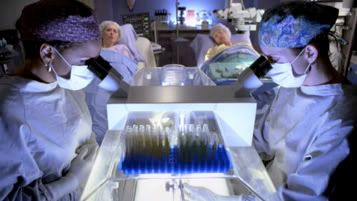
The two doctors explain to the couple that they can do a procedure called microsurgical retrieval of epididymal sperm, or MESA, and then extract the currently ovulating ovum from the wife, and use intracytoplasmic sperm injection (ICSI) to create a viable fetus, which was then immediately placed back into the uterus. The picture above is from this scene; you'll see that the patients were there and talking to the doctors as they performed this several stage complicated procedure all by themselves.
One of the things being talked about is just how real all this medicine was, and from what I saw and know (please correct what I get wrong), the procedures are all actually sound. It's the speed, the setting, and the overall depiction of the entire process that I find problematic. It's one thing to accelerate, for dramatic license, multiple office visits to discuss sperm donation and the details that would make, frankly, for boring television. No one wants to watch people sitting around talking, and it seems that the general knowledge level is such that no one expects to walk in to a fertility specialist office for a first visit, and walk out a hour later with sperm floating in their uterus.
MESA and ICSI are much more obscure, new, and not known procedures. By depicting them as joint events that can be simultaneously with single egg extraction during ovulation, and as something that takes no longer than an office visit instead of a several day if not weeklong or so process, gives an awful lot of false information that specialists then have to work at undoing. It's no longer a matter of educating a patient on a procedure, it's about undoing the subtle information bias that they might not even realize they hold.
Is it irresponsible for a show to compress and simplify a complicated procedure or concept so that it fits into the time allowed for the story? Maybe not, we expect dramatic license when we watch fictional television. The problem is just the degree of license - when you're going out of your way to establish authenticity with realistic imagery and dialogue, and strive for medical accuracy, it seems that putting a limit on just how far you stretch reality has to come in to play, as well.
-Kelly
Everyone, Do the Protein Synthesis Dance!
Wednesday, December 05, 2007
Facebook Saving Face?
Social networking site apologizes to users over flap from new controversial ad feature.
Angry users complained of privacy and truth in advertising violations. To see the whole scoop, click here.
Angry users complained of privacy and truth in advertising violations. To see the whole scoop, click here.
In Sickness, and in Health...Sanctioned Cheating?
When does it become "acceptable" to look the other way or turn the other cheek when a spouse looks outside the marriage for companionship? Perhaps when the spouse faces his or her "darkest night"...
Ethical considerations can become complex when dealing with patients in long-term care situations, and not all spouses would be as loving--or understanding.
Love In the Time of Dementia.
Ethical considerations can become complex when dealing with patients in long-term care situations, and not all spouses would be as loving--or understanding.
Love In the Time of Dementia.
Is Evolutionary Theology the 'middle path'?
Wired's Brandon Keim is writing a few stories about the intelligent design vs evolutionary theory debate and how latest showdown on this will take place in Florida, where opposition is mounting to state -mandated emphasis on the importance of evolution to science education:
" Jesus, meet Darwin...In the aftermath of a Texas education official's dismissal for promoting evolution, I spoke yesterday to Michael Dowd, a leading proponent of evolutionary theology...'Evolutionary theology offers a third way. Rightly understood, evolution is as sacred and meaningful as any of the creation myths,' said Dowd, who quoted biology titan E.O. Wilson, sometimes called Darwin's heir: 'The evolutionary epic is probably the best myth we'll ever have.'"
I love what E. O. Wilson has to say about this in his TED video:
It gives me hope that we can transcend the petty 'culture wars' and find a new way to respect all our biosphere and all living beings.
" Jesus, meet Darwin...In the aftermath of a Texas education official's dismissal for promoting evolution, I spoke yesterday to Michael Dowd, a leading proponent of evolutionary theology...'Evolutionary theology offers a third way. Rightly understood, evolution is as sacred and meaningful as any of the creation myths,' said Dowd, who quoted biology titan E.O. Wilson, sometimes called Darwin's heir: 'The evolutionary epic is probably the best myth we'll ever have.'"
I love what E. O. Wilson has to say about this in his TED video:
It gives me hope that we can transcend the petty 'culture wars' and find a new way to respect all our biosphere and all living beings.
Kudos to the FABsters!
 In response to an invitation from the World Medical Association, a Committee of the International Network on Feminist Approaches to Bioethics, worked over the summer to develop a document aimed at revising the Declaration of Helsinki.
The committee currently is working with FAB Board members to develop a second submission, due in February. In order to keep everyone informed about their work and its impact thus far (notable, I think!), they have posted key documents on the FAB website: the standing version of the Declaration of Helsinki, the first submission to the WMA (forthcoming in the first issue of IJFAB), and finally, a draft of the revised Declaration. This is a great opportunity for this organization and we are sure they will make an important contribution. A Hearty Congratulations!
Tuesday, December 04, 2007
It's Cool to Give Smart Gifts
Over the summer, we talked a bit about it being cool to be smart, and with Chanukah starting today, and other holiday festivities rapidly approaching, what better time is there than to give the girls* in your life gifts to encourage interest in science, maths, medicine and more? My niece isn't quite old enough for any of this yet, but that doesn't stop me from looking (or, truth be told, wanting to play with the stuff myself - most of these would make great gifts for curious adults, too).
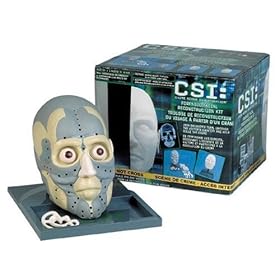 The CSI franchise appears to have a virtual empire of fun lab-related sets, from the CSI Fieldkit, which "comes with a fold-open box containing fingerprinting brushes and colored powder, crime tape, gloves, glasses, crimescope, mini microscope, tweezers, evidence containers, data journal, binoculars, spray bottle, camera, and more" (although apparently not luminol, alas), to the incredibly awesome looking CS Facial Reconstruction Kit, pictured to the left. And of course, no crime lab would be complete without a DNA Lab. "The kit offers instructions for conducting 10 experiments and provides little scientists with a working centrifuge, an electrophoresis chamber, and a three-speed motorized lab unit to carry out the work."
 If the creative mind you're thinking about tends more towards Harry Potter than crime scenes, you're covered there, too. Again, there are quite a few options, but this one stood out for me: the Spells and Potions Science, Chemistry, Physics and Hobby Crafts set. Why not? If we can teach philosophy using pop culture, why can't we teach physics with Harry Potter? I think it's a brilliant idea.
Of course, the other great thing about this is the potential for DIY Biotech - as the processes and chemicals become cheaper and more foolproof, not only do non-professionals and kids have a chance to play and learn, but people who want to experiment and step outside the norm can do things like make art, grow their own skin, or - really, I think the limits are simply your own mind.
I find this incredibly exciting - and really wish I was 10 again!
-Kelly
*Boys, too. But I know I was always the envy of the other girls in my class, just because I had a father who did buy me science kits, let me build computers, have toy microscopes - does anyone else remember those? - and other things that are "typically" considered boy gifts.
The CSI franchise appears to have a virtual empire of fun lab-related sets, from the CSI Fieldkit, which "comes with a fold-open box containing fingerprinting brushes and colored powder, crime tape, gloves, glasses, crimescope, mini microscope, tweezers, evidence containers, data journal, binoculars, spray bottle, camera, and more" (although apparently not luminol, alas), to the incredibly awesome looking CS Facial Reconstruction Kit, pictured to the left. And of course, no crime lab would be complete without a DNA Lab. "The kit offers instructions for conducting 10 experiments and provides little scientists with a working centrifuge, an electrophoresis chamber, and a three-speed motorized lab unit to carry out the work."If the creative mind you're thinking about tends more towards Harry Potter than crime scenes, you're covered there, too. Again, there are quite a few options, but this one stood out for me: the Spells and Potions Science, Chemistry, Physics and Hobby Crafts set. Why not? If we can teach philosophy using pop culture, why can't we teach physics with Harry Potter? I think it's a brilliant idea.Of course, the other great thing about this is the potential for DIY Biotech - as the processes and chemicals become cheaper and more foolproof, not only do non-professionals and kids have a chance to play and learn, but people who want to experiment and step outside the norm can do things like make art, grow their own skin, or - really, I think the limits are simply your own mind.
I find this incredibly exciting - and really wish I was 10 again!
-Kelly
*Boys, too. But I know I was always the envy of the other girls in my class, just because I had a father who did buy me science kits, let me build computers, have toy microscopes - does anyone else remember those? - and other things that are "typically" considered boy gifts.
Subscribe to:
Posts (Atom)


