Wednesday, January 23, 2008

Should genetic researchers be able to share your DNA?


As promised (or warned--I guess it depends on whether you think this is an interesting issue), here is another thing to think about with regard to genetic biobanking studies.

So: say you've agreed to participate in a research study that is trying to identify whether there is a genetic contribution to breast cancer. In this particular study, the researchers will follow a cohort of women who have not developed breast cancer at the time of enrollment. The researchers will take blood samples and do physical exams periodically. They will also sequence your DNA. As time goes on, some number of women in the study cohort will develop breast cancer, and some won't. The researchers will look at the DNA sequences to see whether there are different patterns in the genetics of the women who develop cancer as compared with those who don't. If they find such patterns, they'll go on to investigate what those specific mutations do.

This kind of research, which is called a genome-wide association study, GWAS for short--because it's looking for associations between genetic patterns and disease--is a lot like a fishing expedition. (You can learn more about these studies in this archived Science Friday audio panel with Ira Flatow.) How GWAS's work has a couple of important implications. One is that, for such studies to work at all, researchers need really big datasets to sift through. Another is that the same dataset could be used for lots of different purposes.

For these reasons, and for efficiency and cost-effectiveness reasons as well, the National Human Genome Research Institute (NHGRI) is trying to develop plans to pool or share such datasets across different projects.

Think back to our breast cancer study example. If you'd consented to participate in that study at your local research university, how would you feel about your (de-identified) information being used by researchers somewhere else? Would you feel that you needed to be offered the chance to opt out of this "wide data sharing?" Or would you feel that your original consent covered such subsequent uses?

Here's another permutation to think about. Say the researchers did the breast cancer study, and in the course of that work they noticed that there seemed to be a correlation between certain genetic patterns and alcoholism or schizophrenia. Would it be ok with you for them to pursue this line of inquiry using your genetic information? Would you feel that you needed to be offered the chance to opt out?

You can read about the NHGRI policy, and the scientific community's reaction, in The Scientist, here. Salon.com ran an article a few years ago about a much smaller open-source approach to genetics, here (which is where the nifty kitty photo came from).

Tuesday, January 22, 2008

Embryonic Stem Cells for Therapeutic Cloning in Humans

A California research team has become the first to report, and document, the cloning of a human embryo using donated oocytes (egg cells) and DNA from the cells of an adult donor.
The study has been published online by the journal "Stem Cells."


The experiments, using a technique called somatic cell nuclear transfer (SCNT), provide key steps toward the development of patient-specific embryonic stem cells for use in developing new treatments for conditions such as Alzheimer's disease, Parkinson's disease, and spinal cord injury, among others. The lead author was Andrew J. French, Ph.D., of Stemagen Corp., a private company headquartered in La Jolla, Calif.

In the experiments, the researchers removed the nuclei of mature oocytes from healthy young women who had previously donated eggs for successful infertility treatments. The SCNT technique was then used to insert DNA from an adult male donor into the oocytes. The DNA was derived from a type of cell called fibroblasts, obtained from skin biopsies.

Subsequently, several of the reconstructed oocytes continued to develop as normal embryos, to the blastocyst stage. Extensive and carefully documented genetic tests were performed to confirm the genetic identity of the cloned embryos. In three embryos, tests showed the same DNA as the male fibroblast donor.

In one of the three cases, additional tests showed that the embryo had another type of DNA, called mitochondrial DNA, from both the female oocyte donor and the male DNA donor.

Mitochondrial DNA testing is viewed as an essential proof of successful human cloning -- particularly after previous fabricated reports from a South Korean research group.

The ability to generate stem cells using the patient's own DNA is significant in the treatment of currently incurable degenerative diseases, as well as for cell-based drug discovery. Previous studies reporting the development of cloned human embryos have used embryonic stem cells as the DNA donors.

While the study is an important step toward the development of stem cells for therapeutic cloning, much more research will be needed to confirm and extend the results.


Bobby Fisher, Bioethics, and Asperger's

[Hat tip to colleague Terry Tomsick for bringing this to our attention] In a recent MSNBC article, bioethicist Art Caplan ponders the question "Would you have allowed Bill Gates to be born? Advances in prenatal genetic testing pose tough questions". Upon hearing the very sad
news this past week about the death of chess champion Bobby Fisher – I had to ask the same question: Would you have allowed Bobby Fisher to be born?

While we don't know for sure, Fisher's outrageous and at times hateful and bigoted behavior may have been caused by Asperger's syndrome which is part of the autistic spectrum . Or perhaps Fisher suffered from having an "extreme male brain" as characterized by Simon Baron Cohen, PhD, MPhil, a professor of developmental psychopathology in the departments of psychiatry and experimental psychology, a Fellow of Trinity College, Cambridge, and director of the Autism Research Centre at the University of Cambridge, in the United Kingdom, and author of the book "The Essential Difference: The Truth about the Male and Female Brain".

We may never know the truth but it would be tragic if he were simply remembered as a hateful, reclusive genius and not for the many accomplishments he brought to the world.

Dr. Caplan captures the key bioethical challenge these new genetic technologies and our understanding of the brain pose:

As genetic testing moves into the world of mental health, we are going to face some very tough questions. Will medicine suggest that any and every variation from absolute normalcy is pathological? How can we draw lines between disabling diseases such as severe autism and
more mild differences such as Asperger's, which may give society some of its greatest achievers? Will parents have complete say over the kind of children they want to bear? And what sorts of messages will doctors and genetic counselors convey when talking about risks, probabilities and choices that involve not life and death but personality and sociability, genius and geekiness?

Neither medicine nor the general public are at all ready to deal with the emerging genetic knowledge about autism, Asperger's or other aspects of mental health. But the future of our society may well hinge on how we answer these questions.

Bobby Fisher: May you rest in peace.

Monday, January 21, 2008

UK will allow human-animal hybrids for stem cell research

On January 17, the UK's Human Fertilisation and Embryology Authority (HFEA) granted two universities 1-year licenses to pursue the development of human-animal embryos for research purposes. This is a reversal of prior policy, which banned such transgenic experimentation.

The ultimate aim of this work will be to develop personalized stem cells that can be used to cure disease. The researchers will clone individuals with serious illnesses by inserting their DNA into enucleated cow and rabbit eggs, resulting in hybrid embryos from which stem cells can be extracted. The hybrid embryos are to be destroyed no later than 14 days after they are created. It is hoped that using patients' own DNA in this process will reduce (or, better still, eliminate) the risk of transplant rejection (graft vs. host disease) when the stem cells, or organs grown from them, are implanted in the patient's body.

The UK's approach sidesteps at least two issues that have been problematic for scientists in the US: (1) the destruction of human embryos question (because they're hybrids, not solely human), and (2) the problem of gathering a sufficient number of donated human ova for research purposes. It's at least a little bit interesting to note that public opinion in the UK generally favors this approach, even as the rejection of genetically modified "Frankenfoods" continues to be reported in the news there.

However, US opinion has been quite strongly against such transgenic experimentation, generally because of concerns of developing chimeras with human (or human-like) consciousness. Additionally, the requirement that the chimera embryos be destroyed within 14 days of creation is probably pretty close to unenforceable-which gives rise to the kinds of nightmare scenarios Margaret Atwood contemplated in Oryx & Crake ("baby orchards" for organ transplants).*

So: Does the HFEA's approach create more problems than it solves? Talk amongst yourselves.

News here: The Guardian, Financial Times


*And yes, that's another WBP Book Club selection! Go here for more info.

Sunday, January 20, 2008

2008 State of the States

For folks looking for a good primer on the "state of the states", Stateline.org has published their State of the States 2008 pamphlet. In this, they discuss subjects as broad as the various states both funding and banning human embryonic stem cell research, as well as state abortion laws, Romeo and Juliet laws, campus security, same sex marriage laws, and more. It's 75 pages of data, graphs, and trends - well worth reading for anyone interested in health care, policy, and federalism.

Of particular interest to me was Christine Vestal's analysis of states attempting to attract prominent stem cell researchers to grow their hESC research facilities into world class research labs. Once the fear was federal stem cell research laws would create a brain drain of science talent, as American scientists picked up and moved to countries more open to doing hESC. Now, the concern is the state next door, as California, Connecticut, Illinois, Maryland, New Jersey, New York and Wisconsin have awarded nearly $250 million in grants, which is three times more than the federal government spent in the same time frame.

While some states consider how to keep up with the funding next door (Iowa, Massachusetts and Missouri), others have simply bowed out of the stem cell race (Arkansas, Indiana, Louisiana, Michigan, North Dakota and South Dakota).

The State of the States 2008 document appears to be a great resource, full of interesting information. For example, did you know that 100 bills both for and against hESC research were considered in 39 states, but only three laws actually enacted? (New York State approved its hESC research funding, Iowa repealed a ban, and Illinois confirmed an executive order.)

While the ethics of the research are briefly mentioned (and Jonathan Moreno is quoted, albeit in another section of the article), overall they are given rather short shrift. That flaw aside, however, this appears to be a valuable addition to any researchers stack of pdfs.
-Kelly

More on Big Pharma and Disclosure

I want to agree with Kelly Hills that the FDA as currently structured and funded is not capable of reviewing the information disclosed by insurance companies. It must be a two part plan. First, all the data must be disclosed so that anyone, including independent oversight groups, can look at the data. But second, the FDA needs to be given resources to do the kind of review of this data that safety requires before releasing a drug on the market. Others know more about this than I do, but I have not seen any particular evidence that the FDA has become so politicized that they would not do this review if they had the resources. If, however, that were the case then it would be necessary to fund independent oversight.

Do You Have a Fear Of Clones?

One of the news items that seems to have generated the most buzz on the bioethics blogs is this week's decision by the FDA to allow the sale of meat from cloned animals -- we've posted on it, blog.bioethics.net has, the Business Ethics Blog has, and Art Caplan has written a column on it. And now, an Rick Weiss of the Washington Post reports that consumer groups are pressing for labeling, but the concern is that the labels may not be able to be verified. Additionally, the article reports, consumer groups are wondering "how the FDA will live up to its promise to keep an eye on the quickly evolving field of animal cloning and protect the public from unexpected problems."

It seems to me that Art says it all when he says "Don't ask, don't tell is bad policy for cloned food" (or any food, I might add) and that consumers will have the last word.

Closing the Loopholes for Big Pharma

Today's New York Times reports that about a third of the studies done on Paxil and Prozac went unpublished and (not surprisingly) if those studies were included these drugs were much less effective than when only the positive studies were published. http://www.nytimes.com/2008/01/17/health/17depress.html?
This is only the latest in a series of revelations about the way that pharmaceutical companies (“Big Pharma”) control the data about new drugs which they make available to the FDA in seeking approval and then to the public. No one disputes that these failures to disclose are harmful to the public’s health. Doctors prescribing drugs and using medical devices must have complete information in order to make the best treatment decisions. However, what is lost amidst the hand-wringing is that there is a very simple way to end this pattern and to make this information available to those who need it: require that all information, positive and negative, about drugs submitted for approval to the FDA be made available to a public data base. Current regulatory changes to require greater disclosure are inadequate because if there are any places left to hide negative data, Big Pharma will find a way to get there. Moreover, the arguments that it is somehow unfair to require companies to benefit from information about what doesn't work makes no sense because companies would only have to disclose AFTER they decide it is worth submitting the drug for approval.

Pharmaceutical companies are businesses like any other and are entitled to make a profit and to keep business information private—but only to the extent that it does not harm the public’s health. Having a drug approved for sale in the United States by the FDA is a privilege and it should come with the responsibility of making available all the available information—not just the information which the company chooses to disclose.

While it has always been the case that pharmaceutical companies were able to hide negative results in studies they conducted themselves, the need is much greater following a recent Supreme Court decision, Garcetti v. Cebalos, which held that government employees do not have First Amendment protection for divulging information—even information vital to the public’s safety-which they learn at work. Most people do not know that a growing number of research companies conducted by pharmaceutical companies are channeled through academic medical centers. While Garcetti v. Cebalos, did not involve research scientists it clearly suggests that a medical researcher at a state university which conducts drug trials for pharmaceutical companies could put his or her job at risk by divulging negative results. This silencing of whistleblowers means that without specific legislation that requires the disclosure of all data, wherever acquired, companies can continue to shield negative results from public view.

Of course is o.k. for pharmaceutical companies to make a profit, just as it is for auto companies, but when the product is one that can endanger the public’s health there must be a requirement of full disclosure.


Jennifer S. Bard, J.D., M.P.H.
Alvin R. Allison Professor of Law and Director, Health Law Program Texas Tech University School of Law Associate Professor (Adjunct) Texas Tech University School of Medicine
1802 Hartford Avenue
Lubbock, Texas 79409-0004
Jennifer.Bard@ttu.edu
806.742.3990, ext. 349


http://www.nytimes.com/2008/01/17/health/17depress.html?ex=1201237200&en=bff3cb16e49ff5f0&ei=5070&emc=eta1

UCSF Scrambles to Undo Damage

As I wrote about earlier this week, UCSF researchers released a study linking a new drug-resistant strain of staph known as MRSA USA300 to the gay community, prompting worldwide headlines that read such 1980s flashback headlines as "FLESH-EATING BUG SPREADS AMONG GAYS" and "EPIDEMIC FEARED--GAYS MAY SPREAD DEADLY STAPH INFECTION TO GENERAL POPULATION". Aside from fueling general fears, the report (and headlines) gave ammunition to anti-gay groups like the Concerned Women of America, who used this latest research as a rallying point for their point of view that homosexuality is sexually deviant behaviour, and these infections are proof of it. And while conventional wisdom says everything becomes a fad 20 years after it was originally around, this is one particular period of the 80s I think we could all do without.

Anyhow, the UCSF researchers actually appeared to realize the damage done, and are waging a media war of their own to undo the inaccurate media reports, misconceptions of what their study said, and undermine groups who are trying to twist their study for other agendas. On Friday, the university and its researchers issued an apology, saying
their release had “contained some information that could be interpreted as misleading.”

“We deplore negative targeting of specific populations in association with MRSA infections or other public health concerns,” it concluded. Dr. Henry Chambers, one of the report’s authors and a professor of medicine at the university, said he was surprised by how the report had been spun.

“I think we were looking at this from a scientific point of view and not projecting any political impact,” he said. “We were focusing on the data. You want to make sure it’s as right as possible and written up in a form that reviewers would understand what you’re trying to say, and do it in a clear manner so it’s not subject to misinterpretation. Which is what happened later, it appears.”


What is interesting about this is the acknowledgment by Dr. Chambers that they did not think outside their own discipline when writing their report or releasing the study. While that limited view and hyper-focus was a common and accepted part of a pre-internet academic community, which relied on published journals to transmit information - guaranteeing that at least the media would have to wait to attempt to stir up sensationalist claims. These days of electronic media, however, lead to a situation of electronic publication of paper results, which is how the UCSF MRSA USA300 report was made public. With that comes instant reporting, instant response, and the emphasis moves away from accuracy and towards sensationalism, an effort to attract the viewer eye. How do you compete with that?

The answer, it seems, is simple. You play the same game. Instead of ignoring the potentials of the internet for rapid information dissemination, for instant response, you do what Dr. William H. Parker, clinical professor of obstetrics and gynecology at the University of California, Los Angeles School of Medicine did. You fight fire with fire, create your own email messages with accurate information you encourage people to forward on, and make sure when you release your research results to the public, you consider both your academic peers and the lay people who will see the research. This might mean writing a "dumbed down" or accessible version of your report for release to general media outlets - but isn't that preferable to having your research misinterpreted and misreported?
-Kelly

Saturday, January 19, 2008

Live Streaming Video from the NC Science Blog Conference


Alas, I could not attend the North Carolina Science Blogging Conference because of a conflict, but I am so pleased to see that I can attend virtually at the this web site. As fellow blogger Jennifer Ouellette says on her blog, "Blogging can be a somewhat isolated activity. Sure, there's comments and linkages and fostering online conversations and such, but generally I just plug along, cranking out my two or three posts a week on whatever topic captures my whimsy that day. Honestly? Sometimes I forget that I'm not blogging in a void. Today was a nice reminder that I'm part of a large, vibrant community that is changing the face of science, science journalism, science education, and science communication in some very exciting ways."

So far, the sessions are very informative and interesting -- check it out! What science blogger do you know who has cocktail recipes on their blog, like this one?:

The Black Hole
So called because after one of these, you have already passed the event horizon of inebriation.
1 oz. Kahlua
1 oz. vodka.
.5 oz. Cointreau or Triple Sec.
.5 oz. dark rum
.5 oz. Amaretto
Pour into an old-fashioned glass over (scant) ice. Stir gently.
Watch time slow.

Next year, I have to go this!

Biobanking and you


Imagine this scenario: you're a healthy person, no major complaints. You go for your annual physical exam, and you have a couple of blood tests--standard stuff, checking to make sure your cholesterol's ok, you're not anemic, etc. A couple of weeks go by, you get a card in the mail that says everything's fine. End of story, right?

Maybe not.

Now imagine that the hospital or clinic has retained the blood left over from the tests your dcotor ordered. And further imagine that the hospital or clinic has what's called a biobank or biorepository--that is, a collection of stored tissue for use in research. Your DNA is extracted from the blood sample and sequenced--which means that some piece of your genotype is now known to some researcher (but not to you). In some institutions, this couldn't happen without your explicit (written) informed consent; but in others, it's standard practice that "waste tissue" from blood tests, pathology samples, etc. becomes the property of the hospital or clinic. Should informed consent be required, or is an opt-out model more appropriate?

Generally speaking, biobank participants' DNA samples aren't associated with their name, Social Security Number, street address, or other information traditionally considered "identifying"--but the reality is, nothing is a more precise identifier of who you are than your so-called genetic fingerprint. Is this worrisome?

I'd be interested to hear what others think about this--and, fair warning, I am likely to be asking more questions along these lines, as the DNA biobanking issue is on my mind a lot these days!

While I'm at it, here are two references for further reading, if you are so inclined. The Stored Tissue Issue, from Robert Weir, Robert Olick, and Jeffrey Murray, is an academic treatment of the issues. Michael Crichton's Next is an entertaining look at some of these questions--and it just happens to be a WBP Book Club selection.

Bark, Bark, Woof, Woof -- Lassie Speaks

It was thought for the longest time that humans were the only species that could 'speak' -- then came along Washoe and Koko and Alex, and now, Hungarian researchers have written a promising program that could translate the meaning of dogs' barks, and it could applied to other species as well.

Yet another indication to revisit and enlarge our moral universe.

Friday, January 18, 2008

Medical FICO Scores

There is some talk about getting a Medical FICO score. A FICO score has, so far, been used to judge the credit worthiness of consumers. This Medical FICO scores takes it a step further and finally admits, what the medical industry has known so far: Hospitals dont view the relationship between a doctor and a patient as that of a physician-patient relationship, but that of a provider and a consumer.

I dont disagree with the concept necessarily. The health industry has long been known for losing money on certain patients, and making up money on others. This seems like a way to fix the leakiness problem.

On the other hand, this sounds like a really bad idea from the perspective of a patient, especially because of the multitude of ways it can be expanded. Today, they talk about ability to pay. However, once enough data has been accumulated, the data can be mined to see what was being paid for. What health risks does this patient inherently have? If this patient has risks, maybe we can view her as a "repeat customer." This can lead to targeted ads on one end, and lack of treatment for chronic sufferers on the other end.

I worry about the slippery slope!!

Supremes tell Abigail no: why this is a good thing

Earlier this week, the US Supreme Court declined to hear the appeal of the Abigail Alliance--news from the LA Times here. The advocacy organization sought to change the Food and Drug Administration's policy of prohibiting the use of experimental and unapproved drugs to treat patients. While there are procedures on the books for compassionate use, which allows access for some patients to some drugs under some circumstances, the Abigail Alliance and its supporters believe that the current approach is too narrow, too onerous, and too time-consuming to help all those who could benefit. They sought to make access easier for terminally ill patients who are unable or ineligible to participate in clinical trials.

The Abigail Alliance makes a stirring argument: none of us would want to feel that we were unable to get access to the "silver bullet" that would make our loved one (or ourselves) well again or extend life because of some bureaucratic requirement. And certainly the story of Abigail Burroughs--by all accounts a lovely young woman, who died of a rare form of cancer when she was just 21--is terribly sad.

But does it mean FDA is wrong to deny access to unproven drugs? I don't think so. The FDA's mission is to ensure that the medicines and devices we use to improve human health are safe and effective. This is a vital function and one that must be preserved.

We--by which I mean the general public--have a tendency to assume that drugs are good, that they work, and that they generally don't make people sicker. This is not a great assumption: check out the news earlier this week about Zetia and Vytorin (cholesterol drugs that could actually increase atherosclerosis), or the Vioxx settlement (a pain-reliever that caused heart attacks and strokes in some patients), or reports that suggest that several common drugs for schizophrenia may increase diabetes risk, or fen-phen (an off-label use for weight loss caused permanent heart damage in some patients). These are just a few examples. Drugs can be dangerous. They can make people sicker, and in some cases, they can give people worse problems than they started out with.

"Aha!" the advocates say, "But what about if somebody is already dying? They're as sick as they're going to get. Surely they should be granted access!" Still, in general, I think not. Patients who are terminally ill are the very last people we should be treating with unproven agents. Clinical trials aren't all beer and skittles: If you doubt that drugs can be dangerous, check out reports of the TeGenero trials last summer, in which 6 previously healthy young men ended up in the ICU with permanent immune system damage. These were Phase I safety trials, not Phase II--the category the Alliance wants to make available--but my point is, should we really subject patients to such an ordeal in the pursuit of what is likely an understandable, but unrealizable, dream of a cure?

A key point to understand is that research is different from treatment. Research is directed toward the development of new solutions, and it may or may not benefit those individuals who volunteer to participate. It sounds harsh, but helping volunteers isn't the point of research. Treatment, on the other hand, is all about managing symptoms and effecting cures. It's just plain wrong to represent one as the other.

The legal questions are more subtle: argument in the original case focused on whether terminally ill patients have a Constitutional right to drugs that have passed Phase I clinical testing. Our very own Linda Glenn did a nice overview here.

Thursday, January 17, 2008

Of Note: Five Bionic Technologies, Changing our humanity?


5 technologies that improve mankind, maybe a little too much?


NYS Supreme Court Case Stirs Ethical Debate

As is being being reported in numerous outlets, the NYS Supreme Court will be hearing a civil case filed against NewYork-Presbyterian Hospital by a construction worker who underwent an involuntary rectal examination as part of his trauma assessment. The plaintiff is claiming assault, battery, and false imprisonment for being restrained, sedated, and examined against his wishes. The hospital's response, of course limited due to HIPAA requirements, is that the plaintiff was brought to the ER with head trauma, was combative, and needed to have severe head trauma ruled out. (Apparently a rapid way to assess injury to the nerves of the spinal cord is to check rectal sphincter tone.) The plaintiff resisted, was sedated, and when brought out of sedated, punched a doctor in anger, and was arrested for assault.

None of this in itself is particularly new or newsworthy; it is a continuing debate of what constitutes emergency care, standard care, informed consent, and what it means to have decision making capacity. These debates have been going on for years, and will likely continue for as long as any of us can envision.


No, the interesting thing actually comes from the commentary at City Room, the NYTimes local blog. Reading through the comments gives an eye-opening view into the way the general public perceives medicine, emergency medical care, and doctors. The most fascinating, and oft-repeated claim, is that if the patient (plaintiff) could be be arrested for assault, then he was obviously competent to decide his medical care - that, as one commenter put it,
if the patient’s competence is questioned regarding his ability to make an informed decision, then it’s inconsistent to charge that same incompetent person with assault.

Of course, the best retort to that (also brought up in comments) is that a drunk person is not competent to make decisions - yet is still responsible for the actions they take while drunk. (Also of note is that no one claiming specific background and training in medical ethics has spoken up in the thread. For those of you reading this, with the limited information available, what's your take on the situation?)

Obviously the message of personal autonomy and the basic idea of informed consent has permeated our society, but at a very simplistic level that might actually cause more misunderstanding and difficulty when treating emergency medical cases than potential good. The question becomes then, how do we increase the general knowledge level of the lay person while still emphasizing autonomy, while simultaneously acknowledging the education and superior knowledge of the physician without falling back on paternalism?

For anyone interested in this line of thought, the comments in that thread are well worth the read, and the contemplation.
-Kelly

Wednesday, January 16, 2008

As they say in Hollywood, "It's just an honor to be nominated,"

We were grateful for being given the honor of being nominated in the Best Health Policies/Ethics Weblog Category of the Medagadget's annual Medical Weblog Awards. Congratulations and best of luck to the finalists! -- you can cast your vote here.

Goats in the Road and their cloned CAFO cousins

Some notes from my recent travels:
I'm spending some time with my husband, Kim, in Timor Leste, where he is working on a land tenure property rights program; it is a poor but naturally beautiful country, struggling to regain its independence after a long term occupation. During his pre-dawn jogs, Kim is amused to encounter herds of goats clustered in twos and threes, nestled together in road determined to enjoy last few moments of their nights' rest. They barely flick an ear as he weaves between them, appearing to be no more than darker shadows in the dim morning light; they know the road belongs to them, at least until the break of day. This pre-dawn sedentary determination belies their youthful exuberance during the day. I think of their american cousins in the CAFOs, the FDA's approval of the sale of cloned meat, and it prompts me to consider the relative quality of life of the livestock in Timor Leste as compared to the livestock in the Industrial Food Chain in the US.

What strikes me is that we, in the US, while priding ourselves in the humane treatment of our companion animals, turn a blind eye towards the cruelty of the livestock in our industrial food chains, our CAFOs -- the CAFOs that feed the fast food, cheap food, sugary food industry, arguably the food industry chain that is eroding the quality of life of humans in the US.

My observation is that the goats, pigs, cows, and chickens in Timor Leste have a much more interesting, satisfying, and likely, longer lives than their supposedly "free range" US cousins.

While not meaning to diminish the extreme poverty of the human condition in Timor Leste, the everyday presence of the goats, pigs, cows, and chickens are a reminder that we can learn something about importance of recognizing our interconnectedness and the potential dangers of disconnection and disassociation -- and about the infinity diversity of living things with which we share the planet.

[Addendum, Jan 20, 2008: Colleague Art Caplan writes that Don't ask, don't tell is bad policy for cloned food. -- I might add I think it's bad policy for food in general. Also, Chris MacDonald at the Business Ethics Blog gives a different perspective. ]

Tuesday, January 15, 2008

Casual Contact MRSA

BBC News is reporting something that some have undoubtedly already heard about: that there is a new MRSA strain, USA300, which varies significantly from the MRSA strains we've seen in the past: it's acquired in the community, from skin to skin contact, and not hospital settings.

Up until now, hospitals have been the tried and true mode of infection with any of the multiple drug resistant bugs in our environment, and for decent reason: hospitals, for all their efforts at sterility, house the sickest of the sick, and prove to be breeding grounds for antibiotic resistance.

What's noticeable about USA300 is two things. First is the fact that it's transmitted in the community, by skin to skin contact. While this is generally sexual contact, any sort of prolonged contact with another's skin is enough for transmission, and there is already evidence that this high contact no sex transmission has taken place.

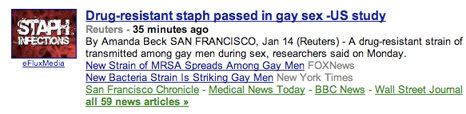
The second interesting thing is that reporting of MRSA USA300 has reminded me of the initial reporting of HIV/AIDS back in the 1980s, albeit on a larger scale. And it might just be my memory of the San Fran/Bay Area reporting filtered through multiple books, novels, and movies, but the tone of the articles - "new outbreak in San Francisco gay community", "gay men affected by new skin to skin disease", etc - is eerily familiar. And I can't decide how I feel about this. On the one hand, it's only responsible to make sure it's clear everyone knows whether or not they're in a vulnerable population group. But on the other hand, it seems like it's walking dangerously close to stigmatization, again. This is alleviated by the acknowledgment of casual, non-sexual skin to skin transmission, but that seems overshadowed by the general tone of the articles I've been reading.

Perhaps most of all, it's disappointing. I would have hoped that these 20-odd years later, people would have learned how to write about an emergent infectious disease without creating, intentionally or otherwise, a stigmatized population group to go with it.
-Kelly

I'm editing this some six hours after the initial post, because I wanted to put up a picture of the kinds of headlines I'm referring to, as well as a link to the Google News collection of these stories - all of which have a disturbingly similar theme in their headlines. Click on the image above to see them all.

Monday, January 14, 2008

Which comes first, the drug or the disease?


Today's NYT reports that Pfizer has begun direct-to-consumer advertising for their drug, Lyrica. It's not a new medication, having been approved for some time for the treatment of nerve pain (as experienced by some people with diabetes or shingles).

What's news is that the advertisements are for a new indication: fibromyalgia. Fibromyalgia is a condition for which no definitive diagnosis exists, and its cause and mechanisms are not understood by medical science. People who have it, most of whom are middle-aged women, complain of chronic, widespread pain and tenderness, as well as extreme exhaustion.

But whether fibromyalgia really exists is a contentious issue. Those who suffer from fibromyalgia insist that it is a real, and debilitating, problem. Numerous advocacy and support groups exist online and offer individuals the chance to compare notes with fellow sufferers. Skeptics charge that it is essentially a psychosomatic complaint--i.e., "it's all in their heads."

A few features of this story are worth comment (in my view, anyway). One is that we should be aware of the long-standing tendency of the medical establishment to minimize symptoms it can't explain by saying they are psychological--i.e., not "really real," and outside the purview of "real medicine." Many of these conditions (like irritable bowel syndrome, multiple chemical sensitivity, and chronic fatigue syndrome) tend to affect middle-aged women more than other groups. Coincidence? Maybe. But maybe not. Either way, it's worth thinking about whether these issues are being too easily dismissed.

Another is the influence that pharmaceutical companies have in our society over what "counts as" illness or disease. On one view, if there's a drug for it, then it's a disease. Thus shy people may actually suffer from social anxiety disorder and require Paxil; short people might have idiopathic short stature and need human growth hormone; and the list goes on. Is this trend toward medicalization a good thing? What does it mean, in practical terms, when we move a condition from the "some people are like this" (normal human variation) column into the "people who are like this have a disease" (illness) column? Who benefits from those effects?

One more thing to consider: the challenge of pain. As a subjectively experienced phenomenon, it's tough for medicine to deal with. Most medical problems are objectively measurable in one way or another, but pain is particularly tough to pin down. People have different pain thresholds, experiencing more or less pain in response to the same stimulus. It's been the standard view for a while now that women experience pain differently from men, though whether these differences are biological or social (or both) is still unclear. And the data source for pain? We mainly have to rely on self-report--and as a general rule, science doesn't like self-reported data. But the flip side could mean denying needed relief to people who are suffering ... and who wants to do that?