Showing posts with label enhancements. Show all posts

Saturday, November 15, 2008

Nip/Tucking Your Way to Beauty Queendom

Friend and colleague Art Caplan comments on the ethical issues surrounding Venezuelan beauty pageants on Bloomberg.com:

"Eva Ekvall says she was 17, a little overweight and dreaming of winning enough to buy a car when she entered her first beauty contest. Plastic surgery was the last thing on the young Venezuelan's mind.

Then she met Osmel Sousa, the Pygmalion of her country's beauty industry. Three months later, weighing 10 kilograms (22 pounds) less, her nose reshaped, and with breast implants, Ekvall was crowned Miss Venezuela...

Cuban-born Sousa, 60, who has run the Miss Venezuela franchise since 1981, is responsible for most of the country's five Miss Universe, five Miss World and five Miss International titles. He openly encourages surgery.

``This isn't a nature contest,'' Sousa said in an interview as contestants in swimsuits and high heels practiced choreography for the 2008 Miss Venezuela pageant, which took place in Caracas on Sept. 10. ``It's a beauty contest, and science exists to help perfect beauty. There is nothing wrong with that.'...

Arthur Caplan, director of the University of Pennsylvania's Center for Bioethics questions Sousa's endorsement of aesthetic surgery.

``No surgeon can say that giving breast implants to a 17-, 18-year-old for beauty reasons is ethical,'' Caplan said by phone from Philadelphia. ``It's terrible that these pageants are turning into plastic surgery competitions and are no longer about real beauty.''

Surgical enhancement is permitted and is common among contestants, said Paula Shugart, president of the Miss Universe Organization, a joint venture between billionaire real estate developer Donald Trump and NBC Universal Inc...." [Full article can be accessed here.]

Saturday, July 12, 2008

A Cure fo MS: Caffeine

by Leane Scoz

Caffeine. The helper that gets people out of bed and out the door in the mornings. The best friend of college students pulling all-nighters. The co-worker that keeps the office staff awake throughout the day. The cure for multiple sclerosis (MS)?

According to a recent Web MD headline on CBS News, a new study involving mice found that large amounts of caffeine blocked key steps in the development of MS. A dose of caffeine, equivalent to six to eight cups of coffee a day, was effective in preventing the compound, adenosine, from getting into the brain and triggering the onset of the disease.

The study is the work of Oklahoma Medical Research Foundation scientist, Linda Thompson, PhD, and according to her, "the results were completely unexpected." The study's principal author, Margaret Bynoe, PhD, does not believe it is wise for people to start drinking more coffee due to these initial results. She acknowledges that caffeine has not been proven to be protective in humans yet and believes future studies may unveil other adenosine blockers that could be more useful. However, the results are still encouraging.

MS is a chronic, often disabling, autoimmune disease that attacks the central nervous system. Numerous physical and mental symptoms occur because of the disease and often progress to physical and cognitive disability. About 400,000 people in the United States have MS. These people are our family members, friends, neighbors, and co-workers. Since a cure does not currently exist for the disease, people suffering from MS rely on treatments, therapies, and research studies for hope.

It is crazy to think that a cure for MS could be in the kitchen pantries of most Americans right now. Hopefully, answers will be available in the near future since studies involving human subjects are in the planning process. Until then, let's all sit back and toast that great cup of java. Who knows...maybe Americans really do run on Dunkin!

Wednesday, June 25, 2008

Do You Tip Your Doc for Botox®?

In the last few years, an increasing number of General Practitioners, Family Practitioners and OB-GYNs in the United States, Canada, and Australia have added revenue-enhancing cosmetic procedures to their core practice. Because 91 percent of cosmetic procedures are performed on women, OB-GYNs have a ready-made client base—but is the integrity of the physician-patient relationship, the practice of medicine, and ultimately the care of patients compromised when physicians offer cosmetic procedures and products that don’t increase the health and welfare of their patients?

“We are physicians who limit our practice to women,” writes David Levine, MD in the Journal of Minimally Invasive Gynecology, an OB-GYN and outspoken proponent of the practice, “and these same women are responsible for the bulk of the $6 billion per year spent on cosmetic treatments, it seems natural for us to consider offering these treatments.”

Levine’s argument seems logical on the surface, but in medicine, what makes sense financially is not always what makes sense ethically. We must face the fact that there are deep ethical implications of the rapidly increasing trend of General Practitioners (GPs) Family Practitioners (FPs) and OB-GYNs adding revenue-enhancing cosmetic procedures and products such as skin rejuvenation, Botox®, Radiesse®, liposuction, breast augmentation, and mesotherapy to their core practice.

As GPs, FPs and OB-GYNs continue to add cosmetic product lines and menus of cosmetic procedures to the general fare of PAP smears and annual checkups, they risk demeaning their profession by creating a public image that physicians are mainly businesspeople working to increase their income. This trend makes it easy for patients to wonder whether their health and safety is the priority or whether the physician’s income is the priority.

Daniel Frank, MD, an internist in Seattle, established his primary care practice in 2002. At the time other primary care practices were starting to offer cosmetic procedures, but he rejected the idea, “When setting up the practice, we were called upon by a number of sales people who wanted us to offer cosmetic procedures. I believe if there is too much of a financial incentive to offer a procedure or service, then my objectivity could be comprised, and even the best and most diligent and objective among us can’t help but be swayed by the economic factors, particularly in primary care. We did not want to detract from our primary mission, which is the care of our patients, so we declined.”

Until the medical community does something about this trend, we as consumers of healthcare need to raise awareness in our GPs, FPs and OB-GYNs. We need to let them know of the potential moral harms of adding cosmetic procedures to their practice, and we need to lobby for reform. Trust is central to the patient-physician relationship and little is more destructive to patient care than a widespread degradation of the public trust in the medical profession.

The integrity of the physician-patient relationship, the practice of medicine, and ultimately the care of patients is compromised when physicians offer cosmetic procedures and products that don’t increase the health and welfare of their patients. Let’s work to make this trend-line spike down.

Read the full Women's Bioethics Project white paper here.

*Question on Yahoo! Answers forum: Do you tip the doctor who does your Botox? How much? Answer: Docs are not supposed to get tipped as it conflicts with their Code of Ethics.

Tuesday, May 13, 2008

Is Life A Gift?

[Cross posted with permission from the IEET site]

By Michael LaTorra


Harvard's Michael Sandel argues in his book The Case Against Perfection: Ethics in the Age of Genetic Engineering that life is a gift and that we should accept the unbidden nature of this gift, working toward acceptance and solidarity with others rather than seeking unbridled mastery over human biology.


But is life properly viewed as a gift?


The claim that life is a gift automatically entails a responsibility on the part of the recipient of that gift to respond with gratitude and without taking issue with the precise attributes and characteristics of what has been given and received. One is supposed to live by the aphorism "Don't look a gift horse in the mouth" (or you might see a lot of rotten teeth). So to accept Sandel's premise that life is a gift is also to accept that one is obliged to respond in a certain way and without closely scrutinizing the actual conditions of what has been received.


But is life a gift at all? The alleged giftedness of life is not inherent in life itself. Something can be given and received without that something being a gift. Communicable diseases are given and received, yet we do not usually consider diseases to be gifts. In some cases, some individuals will say that they learned valuable lessons from their struggle with a disease. In that sense, perhaps we could deem a disease to be a gift. A better term for such an event, however, would be a test.

A test is given and received, just like a gift. However, a test may properly be viewed as fair or unfair, depending on whether the test is appropriate to the skill and knowledge level of the person being tested, and whether the test is free from trickery or deception. We are not expected to have any sense of social obligation to be grateful for being tested. We are not expected to overlook unfairness, bias or deception in the test itself. Indeed, we have a duty to evaluate the fairness of the test so that neither we nor other test-takers should be badly affected by an unfair, biased, deceptive or inappropriate testing instrument.


Life as we currently live it has many undesirable features, such as sickness, old age, too-short duration, painful death, and other limitations. To represent life as a gift without recognizing these negative attributes is to bias the discussion of how life might be improved. If life were merely a gift, one would have to wonder about the motives or competence of whomever chose to give such a gift. If you were shopping for the perfect gift to give someone you loved, would you give them spinal bifida and Huntington's disease?


Life is not always or only a gift. Life is also a test. A crucial element of this test is how life itself might be improved so as to lessen suffering, improve capacity, enhance abilities, and extend the duration of every desirable aspect of life itself. This is the lesson of life. This is how the test is well-met. The true gift of life is to make it better than it was when first received.

Thursday, April 10, 2008

Nature Reports Use of Brain-Boosting Drugs

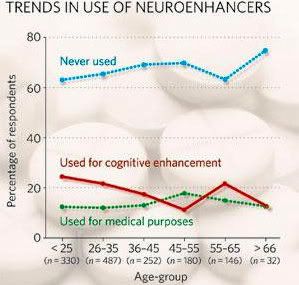
image from nature.comAccording to a new report in Nature, one in five people surveyed have used drugs to boost their mental cognition - and while we know that most people using brain boosting drugs recreationally/academically are students in the 18-25 bracket, there is a (perhaps not) surprising number of academics reporting casual/non-medical use of drugs like Ritalin and Adderall. The study was informal, nonspecific, and international, and most of the 1400 people who responded said that they worked in some medical or education related field, and took the drugs to improve their concentration.

Martha Farah director of UPenn's Center for Cognitive Neuroscience, calls this "America's uncontrolled experiment in pharmacology." The drugs are risky, being taken in an unsupervised manner, and no one really knows what they will do or the long term side effects of taking them on a neurocognitively normal brain. And even more to the point, no one knows where people are receiving their supplies - the internet? Are they even getting what they ordered?

Brendan Maher thinks this is just our competitive nature coming out, wanting something that no one else can have and doing our best to achieve it - or at least take it away from them. I'm not necessarily convinced this is it, or at least all of it - it seems that it is our keeping up with the neighbour instincts coming out, and the desire to make sure we're doing everything we can to be in a competitively even situation with those around us.

Still, given how easy it is for off-share pharmaceuticals to become contaminated, or not made of of the basic ingredient in the first place, the lack of medical supervision and lack of long term followup is worrying. We simply don't know what these drugs will do long term, and what the consequences will be not only for the user but, at least in the case of medical professionls, the people that they treat.
-Kelly Hills