Showing posts with label cognitive enhancment. Show all posts

Wednesday, March 18, 2009

NeuroNews on Wired

Another driveby post: Wired Science has two stories in Neuroscience the last two days that will be sure to be of interest to bioethicists:

Modafinil May Be Addictive:

The alertness drug developed as an addiction-free alternative to amphetamines might be addictive after all.

Researchers have found that people taking modafinil experience a surge of dopamine, an important cognitive neurotransmitter. Such dopamine upswings are seen in people taking Ritalin, and are considered a chemical signature of possible addictiveness. [Link to full article here.]

AND

MRI Lie Detection to Get First Day in Court

Defense attorneys are for the first time submitting a controversial neurological lie-detection test as evidence in U.S. court.

In an upcoming juvenile-sex-abuse case in San Diego, the defense is hoping to get an fMRI scan, which shows brain activity based on oxygen levels, admitted to prove the abuse didn't happen. [Link to full article here.]

Thursday, April 10, 2008

Nature Reports Use of Brain-Boosting Drugs

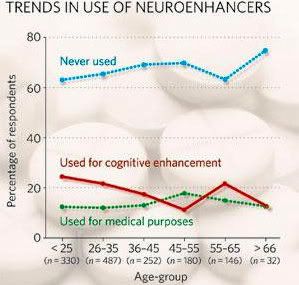
image from nature.comAccording to a new report in Nature, one in five people surveyed have used drugs to boost their mental cognition - and while we know that most people using brain boosting drugs recreationally/academically are students in the 18-25 bracket, there is a (perhaps not) surprising number of academics reporting casual/non-medical use of drugs like Ritalin and Adderall. The study was informal, nonspecific, and international, and most of the 1400 people who responded said that they worked in some medical or education related field, and took the drugs to improve their concentration.

Martha Farah director of UPenn's Center for Cognitive Neuroscience, calls this "America's uncontrolled experiment in pharmacology." The drugs are risky, being taken in an unsupervised manner, and no one really knows what they will do or the long term side effects of taking them on a neurocognitively normal brain. And even more to the point, no one knows where people are receiving their supplies - the internet? Are they even getting what they ordered?

Brendan Maher thinks this is just our competitive nature coming out, wanting something that no one else can have and doing our best to achieve it - or at least take it away from them. I'm not necessarily convinced this is it, or at least all of it - it seems that it is our keeping up with the neighbour instincts coming out, and the desire to make sure we're doing everything we can to be in a competitively even situation with those around us.

Still, given how easy it is for off-share pharmaceuticals to become contaminated, or not made of of the basic ingredient in the first place, the lack of medical supervision and lack of long term followup is worrying. We simply don't know what these drugs will do long term, and what the consequences will be not only for the user but, at least in the case of medical professionls, the people that they treat.
-Kelly Hills

Sunday, March 09, 2008

Is Brain Enhancement Wrong?

In a previous survey on this blog, we had asked if you would take a neuroenhancement drug if it had a minimal side effects and a surprising number of you had said 'yes.' (roughly 52%).
But is that considering 'cheating'? -- The debate continues in an article in the NY Times today:

"In a recent commentary in the journal Nature, two Cambridge University researchers reported that about a dozen of their colleagues had admitted to regular use of prescription drugs like Adderall, a stimulant, and Provigil, which promotes wakefulness, to improve their academic performance. The former is approved to treat attention deficit disorder, the latter narcolepsy, and both are considered more effective, and more widely available, than the drugs circulating in dorms a generation ago."

Full article accessible here.

Thursday, March 06, 2008

The Second Enlightenment Cometh?


If you are a technoprogressive OR a coffee lover, you'll enjoy this article on Wired this week about how the newest cognitive enhancers (as opposed to the 'old' cognitive enhancer, coffee) and technologies will lead to the Second Enlightenment:

" Imagine a drug that can reduce your need for sleep, increase your concentration and make you smarter, with minimal side effects.

Call it Morvigil.

What would such a drug do to society? Would governments ban it, would it become the drug of the rich or become a virtual prerequisite for your workday? ...."

Full text of the article here.


Saturday, January 26, 2008

Headgear that could reverse Alzheimers?


According the Daily Mail, British neuroscientists found that exposing middle-aged mice to infrared light for six minutes a day help to improve their performance in a cognitive tasks. The prototype cognitive helmet, a futuristic looking headset, is scheduled to be tested in the human trials starting this summer. The rest of story here.

Wednesday, December 19, 2007

Running for the shelter of the Mother's Professor's little helper

In this week's issue of Nature, Cambridge University neuroscientists Barbara Sahakian and Sharon Morein-Zamir have penned a commentary entitled "Professor's little helper," which explores, how cognitive-enhancing drugs (like Nootropics and Provigil) are starting to find their way not only the pharmacopoeia that students have relied on at university campuses, but into the lifestyles of medical professionals and academics, which raises some ethical eyebrows.

Has academia become that much of rat race? -- one phrase sums it up: Impact Factor Scores,
Read it and weep. As one modern day philosopher said, "What drag it is getting old."
Rest of the commentary here.